Basic Understanding of Self-Archiving in Library and Information Science:
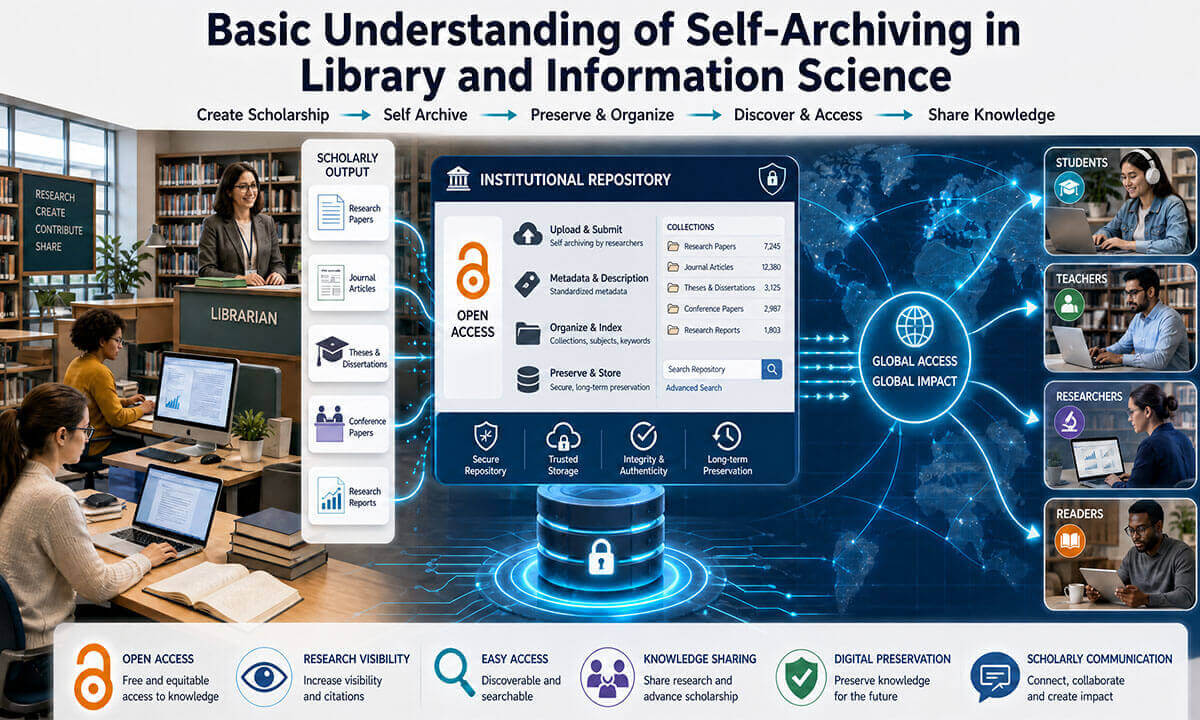
Self-archiving has become an essential part of scholarly communication. It supports wider access to research and helps reduce barriers caused by subscription costs. It can also increase the visibility of researchers and their institutions by making scholarly work easier to discover online. Libraries play a key role by managing repositories, supporting researchers, providing guidance on copyright, and improving the discoverability of archived materials. Therefore, understanding self-archiving is crucial in Library and Information Science. It helps explain how research can be shared, preserved, discovered, and accessed more widely in the digital environment.
What is Self-Archiving?
Stevan Harnad (2001) described self-archiving as the process of depositing research papers in an electronic archive to make refereed research freely available online. He presented self-archiving as a vital route to open access.
The Budapest Open Access Initiative (BOAI) (2002) identified self-archiving as one of the main strategies for achieving open access. It involves researchers making their scholarly work freely available online through open repositories.
Swan and Brown (2005) examined self-archiving as the practice of researchers placing copies of their scholarly works on personal websites or in open access repositories. Their work shows that self-archiving can involve different types of online locations.
Peter Suber (2019) connects self-archiving with Green Open Access, where research is made openly available through repositories rather than directly through an open access journal.
From the above definitions, we can say that self-archiving is the practice of depositing a copy of scholarly work in an online repository or other suitable digital platform so that it can be discovered, accessed, shared, and used by researchers and other users, subject to copyright and publisher policies. It is a necessary method of supporting open access and wider dissemination of scholarly research.
What are the main purposes of self-archiving?
The main purposes of self-archiving are discussed below:
- To Ensure Open Access to Knowledge: One of the main purposes of self-archiving is to make scholarly research freely available. Many academic journals require expensive subscriptions. This can limit access for students, teachers, and researchers. When authors deposit permitted versions of their work in repositories, readers can access the research without paying. For example, a student at a university with limited journal subscriptions can access an accepted manuscript through an institutional repository.
- To Increase the Visibility of Research: Self-archiving can make research easier to discover through search engines, repository search systems, and academic platforms. When a research paper is deposited with proper metadata, such as the author’s name, title, keywords, abstract, and publication date, users can find it more easily. This can increase the online visibility of the research.
- To Improve Readership and Citation Impact: Freely accessible research can reach a wider audience. This includes researchers, students, teachers, practitioners, policymakers, and other users. Wider access can increase readership and may create more opportunities for citations. For example, an openly available article on digital libraries can be accessed by researchers whose institutions do not subscribe to the journal where the article was published.
- To Preserve Scholarly and Institutional Output: Self-archiving also supports the long term preservation of research. Digital repositories can store research files, metadata, and stable links in an organized way. This helps protect important academic materials from being lost. For example, a university repository can preserve students’ theses and faculty publications as part of the institution’s academic record.
- To Support Green Open Access: Self-archiving is an indispensable route to Green Open Access. It allows authors to make their research available through a repository even when the work is published in a subscription-based journal. Depending on the publisher’s policy, authors may be allowed to deposit a preprint, accepted manuscript, or published version. Some publishers may also require an embargo period before the work can be made openly available.
- To Reduce Information Inequality: Many universities and research institutions cannot afford subscriptions to all major academic journals and databases. This problem can be greater in developing countries. Self-archiving helps reduce this information gap by making research available to users who may not have access to expensive resources. It can support more equal access to scholarly information.
- To Comply with Institutional and Funder Requirements: Some universities, governments, and research funding agencies require researchers to deposit their publications or other research outputs in repositories. Self-archiving helps researchers meet these requirements. It can also help ensure that research supported by public funds is made available to the public when permitted by the relevant policies.
- To Showcase Individual and Institutional Achievements: Self-archiving creates a visible record of an author’s academic work and an institution’s research output. Institutional repositories can organize publications, theses, reports, and other materials by author, department, subject, or year. This makes it easier to identify the research contributions of individual researchers and institutions.
What methods are used for self-archiving?
Self-archiving can be carried out through different methods. The appropriate method depends on the type of research material, available institutional facilities, and the copyright policy of the publisher.
- Institutional Repository: Authors can deposit their scholarly work in a digital repository managed by a university, library, or research institution. Institutional repositories commonly contain journal articles, theses, dissertations, conference papers, and research reports. For example, a university teacher may deposit an accepted manuscript of a journal article in the university’s institutional repository.
- Subject-Based Repository: Researchers can deposit their work in repositories that focus on a particular academic discipline. These repositories make subject-specific research easier to find and access. For example, arXiv is widely used for research in physics, mathematics, computer science, and related fields. PubMed Central provides access to biomedical and life science research.
- Preprint Server: A preprint is a version of a research paper that is shared before formal peer review and journal publication. Authors can upload preprints to dedicated servers to share their findings quickly and receive feedback from other researchers. For example, a computer science researcher may upload a paper to arXiv before submitting it to a journal.
- Postprint or Accepted Manuscript Deposit: A postprint, also called an accepted manuscript, is the author’s final version of a paper after peer review but before the publisher’s final formatting and layout. Many publishers allow authors to deposit this version in a repository, although some may require an embargo period. For example, an author may be permitted to deposit an accepted manuscript several months after publication.
- Thesis and Dissertation Repository: Universities often collect electronic copies of students’ theses and dissertations through digital repositories. This helps preserve student research and makes it available to future researchers. For example, a master’s student may deposit a PDF copy of a dissertation in the university library’s repository after completing the degree.
- Research Data Repository: Researchers can deposit datasets, research instruments, questionnaires, software code, and other supporting materials in suitable data repositories. This can support transparency, verification, and reuse of research. For example, a researcher may deposit survey data and related documentation in Zenodo along with a published research article.
- Personal or Departmental Website: Researchers may place permitted copies of their publications on personal academic websites or departmental webpages. For example, a university teacher may maintain a publications page containing links to available versions of research articles. However, institutional and subject repositories are generally more suitable for long-term access because they provide organized metadata, stable links, indexing, and preservation services.
- Academic Social Networking Platforms: Researchers may also share their work through academic networking platforms such as ResearchGate and Academia.edu. These platforms can help researchers increase visibility and connect with other academics. However, they are not normally considered substitutes for trusted repositories for long-term preservation. Researchers should also check copyright and publisher policies before uploading any version of a publication.
Why Is Self-Archiving Important in Library and Information Science?
Self-archiving is important in Library and Information Science because it improves access to scholarly information and supports the sharing of research. Its main importance includes:
- Improves access to research: It allows students, teachers, and researchers to access scholarly works more easily.
- Increases research visibility: Archived research can be discovered through search engines and academic databases.
- Supports open access: It helps make research available to users who may not have access to expensive journals.
- Preserves scholarly work: Digital repositories help store and preserve research materials for future use.
- Supports scholarly communication: Researchers can share their findings with a wider academic community.
- Reduces information barriers: Self-archiving can help users in institutions with limited access to subscription-based resources.
- Supports libraries and institutions: Institutional repositories help libraries organize, manage, preserve, and provide access to the research produced by their institutions.
How Does Self-Archiving Increase Research Visibility?
Self-archiving increases research visibility by making scholarly work easier to find and access online. Its key contributions include:
- Improves discoverability: Research deposited in repositories can be found through search engines and academic databases.
- Reaches a wider audience: Openly available research can reach researchers, students, teachers, and other users from different institutions and countries.
- Provides better metadata: Details such as the title, author, keywords, abstract, and publication date help users find relevant research.
- Increases online presence: A research paper available in multiple trusted digital locations has more opportunities to be discovered.
- Supports readership and citations: When research is easier to access, more people may read it and use it in their own research.
- Improves institutional visibility: Institutional repositories make the research output of universities and research organizations more visible.
How Does Self-Archiving Improve Access to Research?
Self-archiving improves access to research by making scholarly work available online through digital repositories and other platforms. Its focal aids include:
- Provides free access: Readers can access permitted research papers without paying for journal subscriptions.
- Removes access barriers: It helps users who do not have access to expensive academic journals and databases.
- Reaches a wider audience: Research can be accessed by students, teachers, researchers, and professionals from different institutions and countries.
- Allows easy online access: Users can find and access research through search engines and repository search systems.
- Supports quick sharing: Researchers can share their findings with others without depending only on traditional journal access.
- Supports lifelong access: Repositories can preserve research materials and provide continued access for future users.
Challenges That Prevent Researchers from Using Self-Archiving:
Researchers may face several challenges when using self-archiving:
- Lack of awareness: Many researchers do not know about self-archiving or its benefits.
- Copyright restrictions: Publisher policies may limit which version of a paper can be archived.
- Lack of technical skills: Some researchers may not know how to deposit and manage their work in repositories.
- Lack of time: Researchers may consider self-archiving an additional task.
- Limited institutional support: Some institutions do not have proper repositories, policies, or staff support.
- Fear of misuse: Some researchers may worry about plagiarism or unauthorized use of their work.
How Can Libraries Encourage Researchers to Self-Archive Their Work?
Libraries can encourage researchers to self-archive their work in the following ways:
- Create awareness: Explain the benefits of self-archiving to researchers.
- Provide training: Teach researchers how to deposit their work in repositories.
- Offer technical support: Help researchers with uploading files and adding metadata.
- Provide copyright guidance: Explain publisher policies and copyright requirements.
- Develop clear policies: Create simple institutional guidelines for self-archiving.
- Promote the institutional repository: Show researchers how the repository can increase research visibility.
- Provide personal assistance: Offer one-to-one support when researchers need help.
- Recognize researchers: Highlight researchers whose work is successfully archived.
- Make the process simple: Reduce unnecessary steps in the deposit process.
- Regularly promote self-archiving: Use workshops, emails, seminars, and library websites to remind researchers.
In conclusion, self-archiving is an important practice in Library and Information Science. It helps researchers share their work, improve research visibility, and provide wider access to scholarly information. Although challenges such as copyright restrictions, lack of awareness, and limited technical skills can prevent researchers from using it, libraries can provide training, guidance, and technical support. Generally, self-archiving supports open access, research sharing, visibility, and long-term preservation of scholarly work.

is an experienced educator and academic currently serving as a Lecturer at Nurul Amin Degree College. With a career dedicated to student development and institutional excellence, he brings a wealth of classroom expertise and pedagogical knowledge to his current role. Before joining the faculty, he served as an Assistant Teacher at Zinzira PM Pilot School and College.