Cultivating Self-Awareness in Education Through Reflection and Assessment:
Education is not only about gaining knowledge, completing assignments, and earning good grades. It is also about helping students understand themselves as learners and as individuals. One essential part of this process is self-awareness. Self-awareness allows students to recognize their strengths, weaknesses, emotions, learning habits, values, and thought patterns.
Students who understand how they learn are often better able to identify what helps them succeed and what prevents them from making progress. For example, a student may discover that they understand difficult topics better when they break them into smaller parts. Another student may realize that anxiety affects their performance during examinations. Recognizing these patterns gives students an opportunity to make meaningful changes.
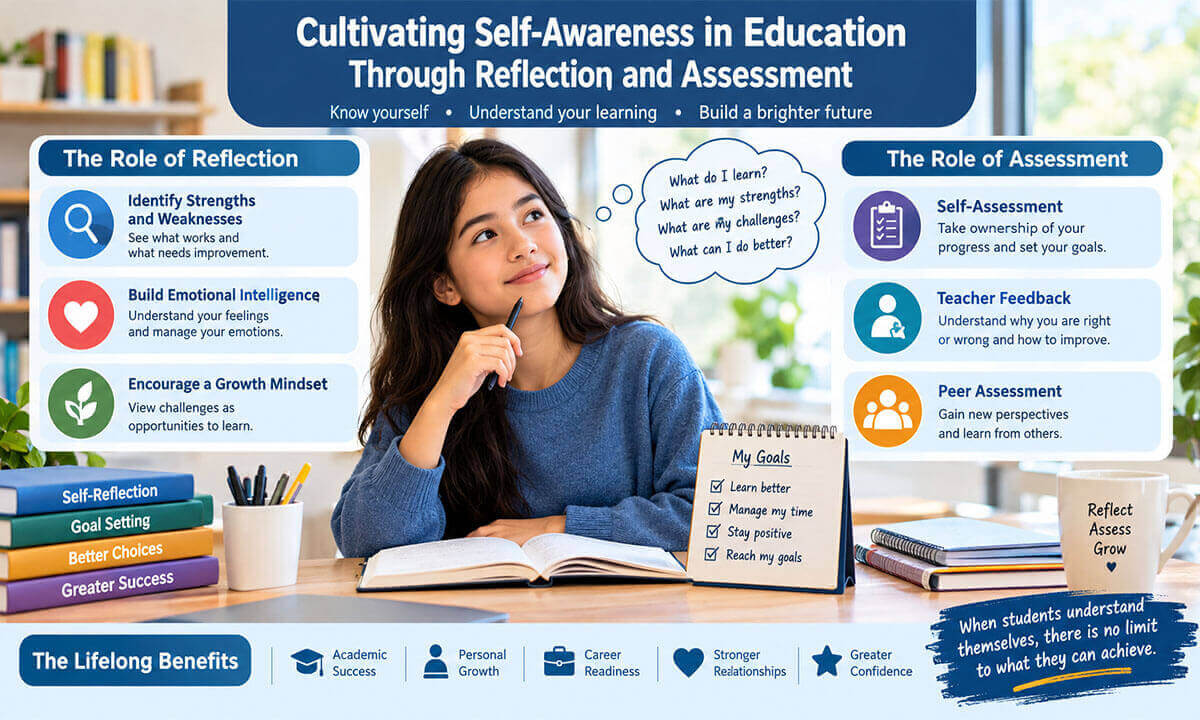
Self-awareness does not develop automatically. It can be strengthened through purposeful reflection, self-assessment, feedback, goal setting, and open communication. When these practices become part of education, students can become more active participants in their own learning.
What Is Self-Awareness in Education?
Self-awareness in education refers to a student’s ability to understand their own learning processes, emotions, behaviors, strengths, weaknesses, and responses to different situations.
A self-aware student can ask questions such as:
- What do I understand well?
- Which areas do I find difficult?
- What learning methods work best for me?
- What emotions affect my learning?
- Why did I make this mistake?
- What can I do differently next time?
- Am I making progress toward my goals?
These questions encourage students to look beyond their grades and examine the processes behind their performance.
Self-awareness is closely connected with metacognition, which involves thinking about one’s own thinking and learning. When students become aware of how they learn, they can choose better strategies, monitor their progress, and make adjustments when necessary.
Why Self-Awareness Matters in Education:
Self-awareness can influence many areas of a student’s educational experience. It can help learners become more independent, responsible, motivated, and adaptable.
1. It Helps Students Understand Their Strengths and Weaknesses: Students do not have the same abilities or learning needs. One student may be excellent at written communication but struggle with mathematics. Another may understand concepts quickly but have difficulty organizing assignments.
Reflection helps students identify these differences without treating weaknesses as permanent limitations.
For example, after receiving feedback on an assignment, a student might recognize that their ideas are strong, but their organization needs improvement. This awareness can guide future efforts.
2. It Supports Independent Learning: Students gradually become responsible for their own learning as they progress through school, college, and university. Self-awareness helps them make informed decisions about how to study, when to seek help, and which strategies to use.
Instead of waiting for a teacher to identify every problem, students can learn to monitor their own progress.
3. It Improves Emotional Awareness: Learning involves emotions. Students may experience confidence, frustration, anxiety, excitement, disappointment, or boredom.
Reflection gives students an opportunity to recognize these emotions and understand how they influence learning. A student who notices that frustration is preventing them from concentrating can take a break, ask for help, or try another learning strategy.
4. It Encourages a Growth Mindset: Self-awareness can help students understand that struggling with something does not necessarily mean they cannot learn it.
Instead of thinking, “I am bad at science,” a student can reflect on the specific difficulty and ask, “Which part of this topic do I not understand yet?”
This shift can encourage persistence and a willingness to learn from mistakes.
The Role of Reflection in Developing Self-Awareness:
Reflection is the process of carefully thinking about an experience, understanding what happened, and considering what can be learned from it.
In education, reflection can take many forms. Students can write reflective journals, participate in classroom discussions, review their assignments, or answer questions about their learning experiences.
1. Reflection Helps Students Examine Their Learning: After completing a task, students can think about what they did, what worked, and what could have been done differently.
For example, after an examination, a student might consider:
- Did I prepare early enough?
- Which topics were difficult?
- Which study methods helped me?
- Did I spend too much time on one topic?
- What should I change before the next examination?
These questions turn an ordinary academic experience into a learning opportunity.
2. Reflection Helps Students Learn From Mistakes: Mistakes are a normal part of learning. However, simply making a mistake does not automatically produce learning. Students need opportunities to understand why the mistake happened.
A reflective approach encourages students to examine the cause rather than simply focusing on the wrong answer.
For example, if a student receives a low score on an assignment, reflection can help determine whether the problem was lack of preparation, misunderstanding of the topic, poor time management, unclear writing, or another factor.
3. Reflection Supports Emotional Development: Students can also reflect on their emotional experiences.
They might ask:
- How did I feel during this activity?
- What caused my frustration?
- What helped me regain concentration?
- When did I feel most confident?
- How did my emotions affect my performance?
Such questions can help students become more aware of the relationship between emotions and learning.
The Role of Assessment in Developing Self-Awareness:
Assessment is often associated with examinations, grades, and academic performance. However, assessment can also be a powerful tool for developing self-awareness.
When students participate actively in assessment, they can learn to monitor their own progress and understand what they need to improve.
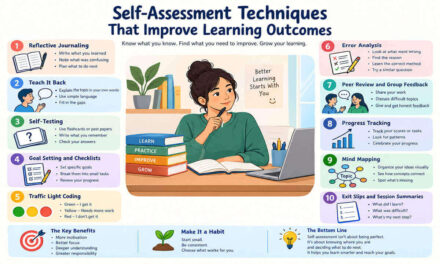
1. Self-Assessment Encourages Responsibility: Self-assessment asks students to evaluate their own work against clear expectations or criteria.
Students might consider:
- Did I achieve the learning objective?
- Which part of my work is strongest?
- Where did I experience difficulty?
- What should I improve?
- What will I do differently next time?
This encourages students to take greater responsibility for their education.
2. Teacher Feedback Provides Another Perspective: Teachers can provide information that students may not recognize themselves. Effective feedback should not only identify errors. It should help students understand how they can improve.
For example, instead of simply saying that an essay needs improvement, a teacher can explain that the main argument is clear, but the supporting evidence needs to be more specific.
Students can then reflect on the feedback and decide what action to take.
3. Peer Assessment Builds Awareness: Peer assessment allows students to review and discuss each other’s work. This can expose learners to different approaches and perspectives.
When students evaluate another person’s work, they may also notice similar strengths or weaknesses in their own work. For example, while reviewing a classmate’s presentation, a student may realize that their own presentation also contains too much information and needs clearer organization.
Peer assessment can therefore support both academic learning and self-awareness.
Practical Strategies for Cultivating Self-Awareness:
Teachers can use several simple strategies to make self-awareness part of everyday education.
1. Use Learning Journals: Learning journals provide students with a regular space to record their experiences.
Students can write about what they learned, what they found difficult, what strategies they used, and what they want to improve.
The purpose is not to produce perfect writing. The purpose is to encourage thoughtful reflection.
2. Encourage Goal Setting: Students can set specific learning goals before beginning a task.
For example: “I will complete my research assignment two days before the deadline.”
After completing the assignment, the student can evaluate whether the goal was achieved and identify the factors that influenced the result.
This creates a simple cycle of planning, action, assessment, and reflection.
3. Use Self-Assessment Checklists: Checklists can make reflection easier for students.
Before submitting an assignment, students can ask:
- Did I answer the question?
- Did I provide enough evidence?
- Did I organize my ideas clearly?
- Did I check for errors?
- Did I meet the requirements?
These simple questions encourage students to review their work independently.
4. Create Reflection Questions After Activities: Teachers can spend a few minutes at the end of a lesson asking students to reflect.
Questions might include:
- What was the most essential thing you learned today?
- What was difficult?
- What question do you still have?
- Which learning strategy helped you?
- What would you like to understand better?
These activities do not require large amounts of classroom time.
5. Encourage Students to Track Their Progress: Students can keep records of their goals, assignments, test results, or skills they are developing.
Progress tracking allows them to see changes over time. It can also help them recognize that improvement is often gradual.
6. Use Mindfulness Activities: Simple mindfulness activities can help students pay attention to their thoughts, feelings, and surroundings.
Short breathing exercises or quiet moments before a lesson may help students become more aware of their emotional state and prepare themselves for learning.
These activities should be appropriate for the age and needs of the students.
7. Encourage Open Conversations: Students need an environment where they can discuss difficulties without feeling embarrassed or judged.
Teachers can encourage students to talk about academic challenges, learning strategies, mistakes, and goals. Such conversations can make reflection a normal part of education.
The Importance of Teacher Support:
Teachers play a vital role in developing student self-awareness. They can model reflective thinking by explaining how they approach problems, respond to mistakes, and adjust their strategies.
Teachers can also create classroom environments where mistakes are treated as opportunities for learning rather than simply as failures.
Instead of asking only, “What is the correct answer?” teachers can also ask, “How did you reach that answer?” or “What made you choose this approach?”
These questions encourage students to examine their thinking processes.
Challenges in Developing Self-Awareness:
Although self-awareness has many benefits, developing it can present challenges.
Some students may initially find reflection uncomfortable because they are not used to examining their own learning. Others may provide very general answers such as “I need to study harder” without identifying the specific reason for a problem.
Teachers can address this by providing clear examples and structured questions.
Time can also be a challenge. Teachers already have many academic responsibilities, so reflection activities need to be practical and connected to existing lessons rather than treated as an entirely separate task.
Another challenge is honesty. Students may sometimes give answers they think teachers want to hear. Creating a supportive environment can encourage more genuine reflection.
How Technology Can Support Self-Awareness:
Technology can provide additional opportunities for reflection and assessment. Digital portfolios can allow students to collect their work and observe their development over time.
Online quizzes, learning platforms, progress dashboards, and digital journals can also help students monitor their learning.
However, technology should support reflection rather than replace it. A score alone does not explain why a student performed well or poorly. Students still need opportunities to interpret results and decide what to do next.
Long-Term Benefits of Self-Awareness:
The benefits of self-awareness extend beyond formal education.
Students who learn to evaluate their own strengths, weaknesses, emotions, and learning strategies may be better prepared to handle new challenges throughout their lives.
In higher education, they may need to manage their own schedules and learning responsibilities. In the workplace, they may need to respond to feedback, learn new skills, solve problems, and adapt to changing situations.
Self-awareness can also support personal relationships because understanding one’s own emotions and reactions can make communication and problem-solving easier.
Most decisively, self-awareness encourages a sense of responsibility. Students learn that improvement is not simply something provided by teachers. They also have an active role in their own development.
In conclusion, cultivating self-awareness in education requires more than asking students to achieve higher grades. It involves helping them understand how they learn, how they respond to challenges, what influences their performance, and what they can do to improve.
Reflection and assessment are two necessary tools in this process. Reflection gives students opportunities to examine their experiences, while assessment helps them understand their progress. Self-assessment, teacher feedback, peer assessment, learning journals, goal setting, progress tracking, and open conversations can all contribute to this development.
When students regularly ask themselves what they learned, what challenged them, what worked, and what they can change, they become more active participants in education.
The ultimate goal is not to create students who simply know more information. It is to help develop learners who understand themselves, respond thoughtfully to challenges, learn from mistakes, and take responsibility for their continued growth. This makes self-awareness an important part of meaningful education and lifelong learning.

is an experienced educator and academic currently serving as a Lecturer at Nurul Amin Degree College. With a career dedicated to student development and institutional excellence, he brings a wealth of classroom expertise and pedagogical knowledge to his current role. Before joining the faculty, he served as an Assistant Teacher at Zinzira PM Pilot School and College.