How Self-Reflection Prepares You for Lifelong Learning:
Self-reflection is the simple habit of taking time to think about what we do, how we respond, and what we learn. In our busy lives, it is easy to forget this important practice. However, self-reflection helps us understand our experiences, learn from our mistakes, and improve over time. It can also build the mindset needed for lifelong learning and personal growth. In the rest of this article, we will explore how self-reflection prepares you for lifelong learning.
What Exactly Is Self-Reflection?
Self-reflection is the process of taking time to look at your experiences, thoughts, feelings, and actions. It means thinking carefully about what happened and how you responded. It also means asking yourself what you can learn from the experience.
Self-reflection is like looking into a mirror. However, instead of looking at your appearance, you look at your thoughts, choices, and behavior. You try to understand yourself more clearly and recognize areas where you can improve.
For example, after an important conversation, you might ask yourself why you responded in a certain way. You may think about whether your words were helpful or whether you could have handled the situation differently. You can also consider what the experience taught you.
Some simple questions can help with self-reflection:
- Why did I make this choice?
- How did I feel about what happened?
- What did I do well?
- What could I have done better?
- What did I learn from this experience?
- What can I do differently next time?
Self-reflection is not about blaming yourself or focusing only on your mistakes. Instead, it is about being honest with yourself and understanding your experiences. It helps you recognize your strengths, learn from difficulties, and make better choices in the future.
When practiced regularly, self-reflection can support personal growth and continuous learning. It helps you turn everyday experiences into valuable lessons that can guide you throughout life.
Lifelong Learning Is More Than a Buzzword:
Lifelong learning is not limited to people who sit in classrooms or work toward another degree. It is something everyone can practice at every stage of life. People continue to learn whether they are 22, 52, or 72.
Learning can happen in many everyday situations. You may learn a new skill at work, read a book that changes the way you think, or make a mistake and learn how to handle a similar situation better next time.
Lifelong learning is a mindset. It means staying curious, being open to new ideas, and being willing to adapt when life changes. Self-reflection can help develop this mindset because it encourages people to look at their experiences and learn from them.
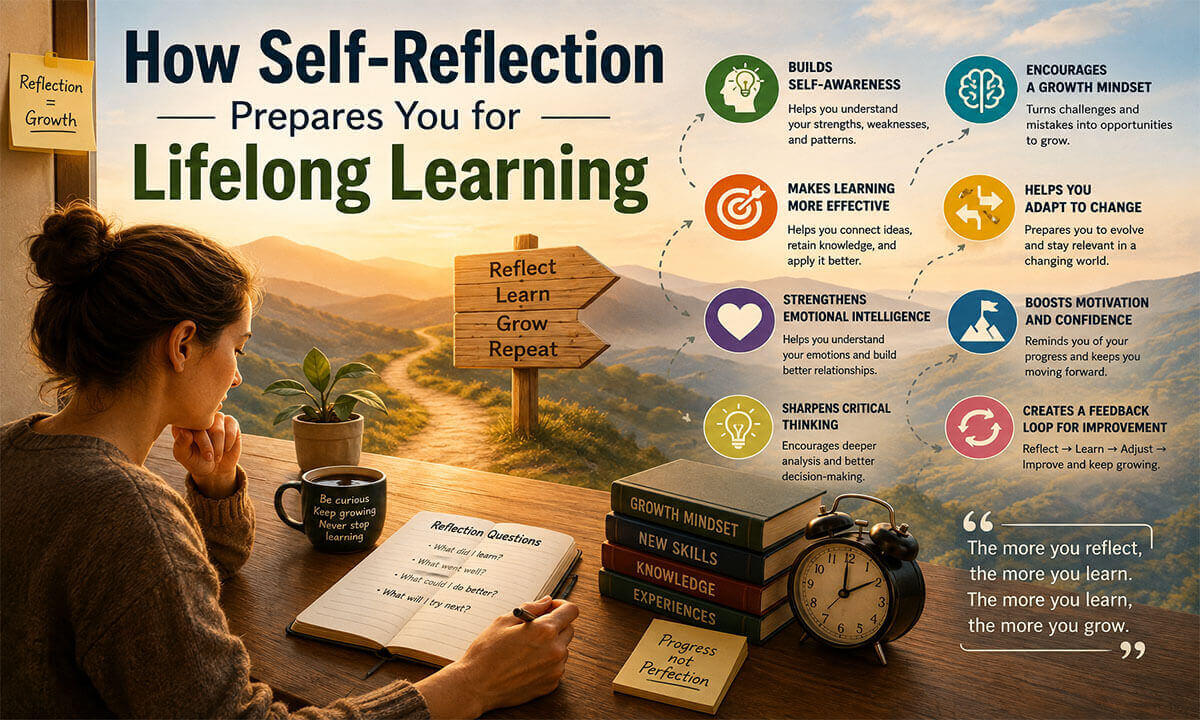
Here are some necessary ways self-reflection supports lifelong learning:
1. Self-Reflection Builds Self-Awareness: Learning becomes easier when you understand yourself. Self-awareness means knowing your strengths, weaknesses, feelings, habits, and reactions.
Self-reflection helps you develop this understanding. When you regularly think about your actions and experiences, you begin to notice patterns in the way you think and behave.
For example, you may realize that you understand information better when you practice it rather than simply reading about it. You may also notice that certain habits make it harder for you to concentrate.
This awareness can help you:
- Recognize areas where you need to improve.
- Understand which learning methods work best for you.
- Identify habits that support or limit your progress.
- Learn from your previous mistakes.
In this way, self-reflection helps you take greater responsibility for your own learning.
2. Self-Reflection Encourages a Growth Mindset: People can have different beliefs about their abilities. A person with a fixed mindset may believe that intelligence and abilities cannot change very much. A person with a growth mindset believes that abilities can develop through effort, practice, and learning.
Self-reflection can encourage a growth mindset. It helps you look at your experiences and think about what you can do differently.
You can ask yourself:
- What did I try?
- What worked well?
- What did not work?
- What did I learn?
- What should I try next?
These questions change the way you look at mistakes. Instead of seeing a mistake as proof that you cannot succeed, you can see it as an opportunity to learn.
Failure can become useful information. It can show you what needs to change and help you choose a better approach next time.
3. Self-Reflection Makes Learning More Effective: Simply repeating information does not always lead to meaningful learning. People learn more effectively when they think about what they have learned and connect it with their previous knowledge and experiences.
Self-reflection gives you time to process new information. It helps you understand important ideas, identify connections, and consider how you can use what you have learned.
For example, after reading an article or completing a course, you can ask yourself what the main lesson was and how it relates to your own life or work.
This simple process can help turn information into useful knowledge. Instead of simply collecting facts, you begin to understand their meaning and practical value.
4. Self-Reflection Helps You Adapt to Change: Change is a normal part of life. New technology appears, workplaces change, new responsibilities arise, and career paths can take unexpected directions.
To deal with these changes, people need to keep learning. Sometimes they also need to let go of old habits and learn new ways of doing things.
Self-reflection can make this process easier. When something changes, you can look at what you already know and consider what needs to change.
You can ask yourself:
- What do I already understand?
- What do I need to learn?
- Which old habits are no longer useful?
- What can I do to adjust?
For example, when a workplace introduces new software, self-reflection can help you think about how you handled similar changes in the past. Remembering previous successes can give you confidence to learn the new system.
5. Self-Reflection Strengthens Emotional Intelligence: Lifelong learning is not only about technical knowledge and practical skills. It also includes learning how to understand yourself and work well with other people.
Emotional intelligence involves understanding emotions and responding to them in healthy and effective ways. Self-reflection can help develop this ability.
When you think about your emotions and reactions, you may begin to understand why certain situations affect you strongly. You may also notice how your words, tone, or behavior affect other people.
After a tough conversation, for example, you might ask:
- Why did the conversation become difficult?
- How was I feeling at the time?
- Did my tone affect the situation?
- How could I respond differently next time?
These questions can help you develop greater emotional awareness, empathy, and self-control. These qualities are valuable in education, work, relationships, and everyday life.
6. Self-Reflection Increases Motivation and Confidence: Sometimes learning can feel slow. You may work hard but feel that you are not making enough progress.
Self-reflection can help you notice progress that you might otherwise overlook. Looking back at your previous achievements can remind you of how much you have already learned.
Even small achievements matter. Learning a new skill, overcoming a difficult problem, or becoming more comfortable with a challenging task can all show progress.
Recognizing these improvements can increase confidence. It can also motivate you to continue learning when the next challenge appears.
7. Self-Reflection Helps Personalize Your Learning: There is no single learning method that works equally well for everyone. Some people learn best by reading. Others understand ideas more easily through discussion, practice, demonstrations, or hands-on activities.
Self-reflection can help you discover what works best for you.
You can ask yourself:
- When do I learn most effectively?
- Which learning methods help me remember information?
- What kind of environment helps me concentrate?
- What usually distracts me?
- What makes learning enjoyable for me?
The answers can help you adjust your learning habits. When your learning approach fits your needs, learning can become more effective and enjoyable.
8. Self-Reflection Develops Critical Thinking: Learning is not simply about accepting information. It also involves questioning, analyzing, comparing, and understanding ideas.
Self-reflection supports critical thinking because it encourages you to examine your own thoughts and assumptions. You learn to look at situations from different points of view instead of accepting your first impression.
For example, when you learn something new, you can ask why you believe it, what evidence supports it, and whether there may be another way to understand the issue.
This habit can improve your ability to solve problems and make thoughtful judgments. It is useful not only in education but also at work and in everyday decision-making.
9. Self-Reflection Improves Decision-Making: The choices people make are often influenced by their previous experiences. Self-reflection helps people learn from those experiences.
When you think about a previous decision, you can consider what happened after you made it. You can identify what worked, what went wrong, and what you might do differently in the future.
This process encourages more thoughtful decision-making. Instead of reacting immediately, you become more likely to consider possible consequences and different options.
Over time, this can help you make wiser and more informed choices.
10. Self-Reflection Creates a Cycle of Improvement: Self-reflection can create a simple cycle of continuous improvement. First, you take action. Then, you observe the result. After that, you think about what happened and identify what you learned. Finally, you use that learning to guide your next action.
For example, a student may try a new study method, review the results, and realize that it did not work well. Through reflection, the student can identify the problem and try a different method.
The same process can be used at work, in relationships, and in personal development.
In this way, every experience can become a learning opportunity. Good experiences can show you what to continue doing, while difficult experiences can show you what needs to change.
Self-reflection therefore becomes an important part of lifelong learning. It helps people learn from experience, make better choices, adapt to change, and continue growing throughout life.
Practical Tips to Start Self-Reflecting Even If You Are Busy:
Self-reflection does not have to take a lot of time. You do not need a special place or a complicated routine. Even a few quiet minutes can help you think about your experiences and learn from them. The most significant thing is to make reflection a regular habit. Here are some simple ways to get started.
1. Start a Reflection Journal: Writing in a journal is one of the easiest ways to practice self-reflection. You do not need to write several pages every day. Spending just five to ten minutes can be enough.
At the end of the day, take a few minutes to write about what happened and how you felt. Focus on what you learned rather than simply describing everything you did.
You can use questions such as:
- What was challenging for me today?
- What did I do well?
- What am I proud of today?
- What did I learn from my experience?
- What could I do better tomorrow?
Progressively, your journal can help you notice patterns in your thoughts, habits, and behavior.
2. Schedule a Weekly Reflection: If daily reflection feels difficult, try doing it once a week. Set aside about 15 to 20 minutes at the end of the week.
Find a quiet place where you can think without interruptions. Put your phone away and give yourself some time to review the past week.
Think about what went well, what was difficult, and what you learned. You can also think about what you want to change or improve during the following week.
A regular weekly check-in can help you stay aware of your progress without making reflection feel like another major task.
3. Use Voice Notes: Not everyone enjoys writing. If you find journaling difficult, you can use voice notes instead.
Open the voice recorder on your phone and speak about your thoughts and experiences. You can talk for a few minutes about what happened, how you felt, and what you learned.
Speaking can sometimes make your thoughts clearer. It can feel like having a simple conversation with yourself.
You can listen to your older recordings later and notice how your thoughts, skills, and understanding have changed gradually.
4. Reflect With Someone You Trust: Self-reflection does not always have to be done alone. Talking with a trusted friend, teacher, mentor, or coach can also help.
Share what you have learned, describe a challenge you faced, and explain how you responded. Another person may notice something that you did not see yourself.
Talking about an experience can also help you organize your thoughts and understand your feelings more clearly.
The goal is not to ask someone else to judge you. It is to have a useful conversation that helps you learn and grow.
Make Reflection a Small and Regular Habit:
The key to effective self-reflection is consistency. You do not need to spend a long time thinking about yourself every day. A few honest minutes can be valuable when you make them part of your routine.
Start with one method that feels comfortable. Write in a journal, record a voice note, spend a few quiet minutes each week, or talk with someone you trust.
With regular practice, self-reflection can become a natural part of learning. It can help you understand your experiences, recognize your progress, and make better choices as you continue to grow.
In conclusion, learning is not only about collecting information. We learn more deeply when we take time to think about our experiences and understand what they teach us.
Self-reflection helps us do this. It can increase self-awareness, improve critical thinking, build confidence, and help us learn from both success and failure. It also helps us adapt to change and make better choices.
For anyone who wants to keep learning throughout life, self-reflection is a simple but valuable habit. By taking a little time to look back, learn, and think about what to do next, we can continue to grow both in knowledge and in understanding ourselves.

is an experienced educator and academic currently serving as a Lecturer at Nurul Amin Degree College. With a career dedicated to student development and institutional excellence, he brings a wealth of classroom expertise and pedagogical knowledge to his current role. Before joining the faculty, he served as an Assistant Teacher at Zinzira PM Pilot School and College.