Limitations of Social Sciences Research:
Social science research is the systematic study of human behavior, social relationships, institutions, communities, cultures, and social problems. It includes disciplines such as sociology, psychology, economics, political science, anthropology, education, and social work. Social science research helps researchers understand how people behave, how societies function, and how social conditions influence individuals and communities. It also provides useful information for developing policies, improving education, addressing social problems, and supporting social development.
However, conducting research in the social sciences is often more difficult than studying physical or natural phenomena. Human beings are complex, and their behavior can change according to their experiences, social environment, culture, emotions, beliefs, and circumstances. Researchers also have to deal with ethical responsibilities, measurement difficulties, cultural differences, and changing social conditions. As a result, social science research has several limitations that can affect the accuracy, reliability, interpretation, and generalizability of research findings. The major limitations of social science research are discussed below:
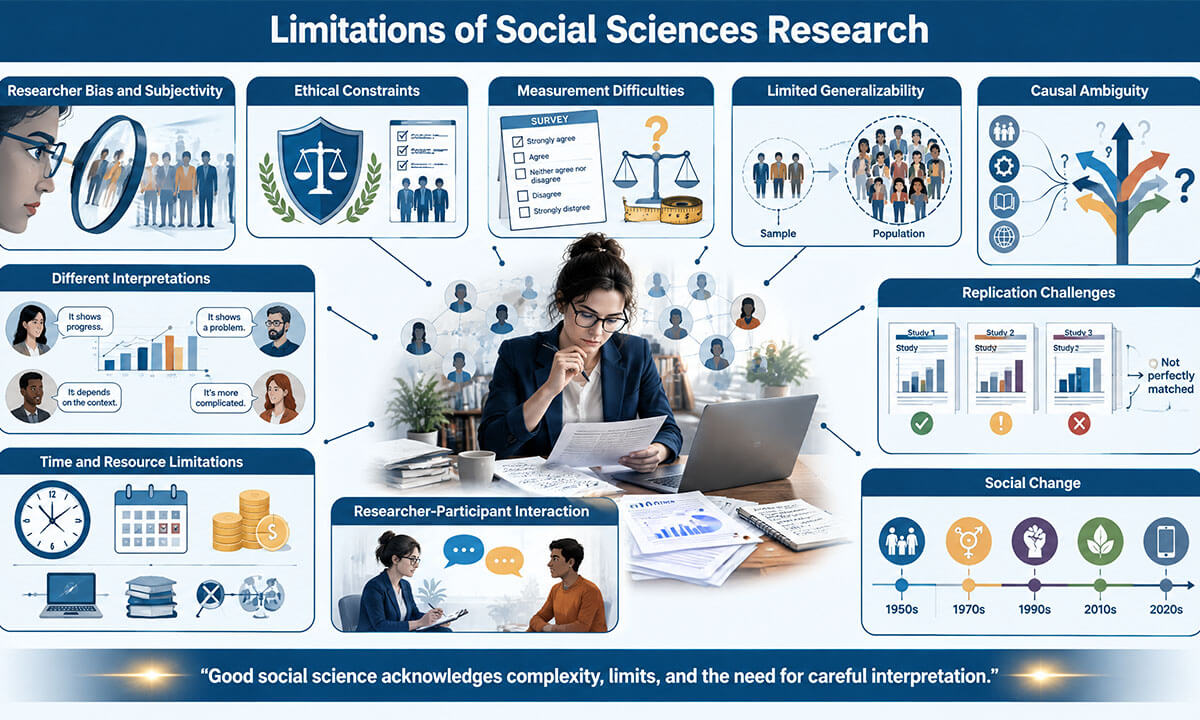
1. Subjectivity and Researcher Bias:
Researchers are human beings who have their own experiences, beliefs, cultural backgrounds, values, and expectations. These factors can sometimes influence the way they design a study, collect information, analyze data, or interpret findings.
For example, a researcher studying poverty may have particular ideas about its causes. These ideas may influence the questions asked during interviews or the interpretation of participants’ responses. Even when researchers try to remain objective, unconscious assumptions can sometimes affect their work.
Qualitative research can be particularly affected because researchers often interact directly with participants and interpret their words, experiences, and behaviors. Researchers can reduce this problem through careful research design, transparent methods, reflexivity, peer review, and the use of multiple sources of evidence. However, completely eliminating subjectivity can be difficult.
2. Ethical Constraints:
Social science research frequently involves human participants. Therefore, researchers must follow important ethical principles. Participants should normally provide informed consent, and researchers must protect their privacy and confidentiality. Researchers should also take reasonable steps to prevent physical, psychological, social, or economic harm.
These ethical requirements are necessary for protecting participants, but they can also limit what researchers are able to study and how they can conduct research.
For example, researchers may want to study highly sensitive subjects such as domestic violence, discrimination, illegal activities, or traumatic experiences. Asking participants detailed questions about such issues may create emotional or social risks. Researchers therefore have to balance the need for information with their responsibility to protect participants.
Ethical requirements can also make certain experiments impossible. Researchers cannot deliberately expose people to harmful situations simply to observe their behavior. This limits the ability to conduct some forms of experimental research in the social sciences.
3. Measurement Challenges:
Several necessary concepts in social science are abstract and difficult to measure accurately. Concepts such as happiness, intelligence, social class, culture, prejudice, trust, power, motivation, satisfaction, and quality of life cannot always be directly observed or measured in the same way as physical objects.
Researchers therefore use questionnaires, interviews, observation, scales, tests, and other instruments to measure these concepts. However, these methods may not capture every aspect of a person’s experience.
For example, two people may receive the same score on a happiness questionnaire but experience happiness in very different ways. Similarly, an individual’s response to a question may change depending on their mood or the situation in which the question is asked.
Poorly designed measurement tools can therefore produce inaccurate or incomplete information. Researchers need to carefully establish the validity and reliability of their measurement instruments.
4. Problems of Generalizability:
Social groups differ considerably in terms of culture, age, gender, education, economic conditions, religion, geographical location, and social values.
A study conducted among university students in one country may produce findings that do not apply to older adults or students in another cultural environment. Similarly, research conducted in an urban community may not accurately represent people living in rural areas.
Sample size and sampling methods also affect generalizability. If a study uses a small or highly specific sample, its findings may have limited application beyond that group.
Researchers can improve generalizability by using appropriate sampling methods and by clearly describing the population and context in which the study was conducted. Nevertheless, social differences make universal conclusions difficult.
5. Causal Ambiguity:
Establishing clear cause-and-effect relationships is another major challenge in social science research. Human behavior is usually influenced by several factors at the same time.
For example, academic performance may be influenced by family background, economic conditions, teaching quality, motivation, health, peer relationships, access to technology, and many other factors. It can therefore be difficult to determine whether one particular factor directly caused a specific outcome.
Researchers can use experimental designs, longitudinal studies, statistical controls, and other methods to investigate causal relationships. However, many social phenomena cannot be studied through controlled experiments because of ethical, practical, or social limitations.
As a result, researchers often need to be cautious when interpreting relationships between variables. A correlation between two factors does not necessarily mean that one factor directly causes the other.
6. Replicability Problems:
Replicability refers to the ability of researchers to repeat a study using similar methods and obtain reasonably comparable findings. Replication is important because it helps researchers determine whether a finding is reliable.
Social science research can be difficult to replicate exactly because social environments change. Participants may differ, cultural conditions may change, and historical circumstances may influence behavior.
For example, a study of social media behavior conducted several years ago may produce different results if repeated today because technologies, platforms, social norms, and patterns of communication have changed.
This does not mean that social science research cannot be replicated. Rather, exact replication can be more difficult than in some controlled natural science experiments. Researchers therefore need to provide detailed information about their methods and research context to support future replication.
7. Influence of Social Change:
Society is constantly changing. Technology, economic conditions, political institutions, cultural values, education, family structures, and communication patterns can all change over time. These changes can affect human behavior and social relationships.
Consequently, research findings may lose some of their relevance as social conditions change. A study of employment patterns, for example, may produce different results after major technological changes or economic transformations.
This means that researchers sometimes need to conduct new studies to determine whether earlier findings remain applicable. Social research therefore needs to consider historical and cultural context rather than assuming that findings remain unchanged indefinitely.
8. Researcher and Participant Interaction:
In many qualitative studies, researchers interact directly with participants through interviews, focus groups, observations, or discussions. This interaction can influence the information participants provide.
Participants may change their answers because they want to create a positive impression of themselves. This is sometimes referred to as social desirability bias. They may avoid discussing sensitive issues or provide answers that they believe the researcher expects.
The characteristics of the researcher can also influence participant responses. Factors such as age, gender, professional position, cultural background, language, or communication style may affect how participants respond.
Researchers can reduce these effects by developing trust, using neutral questions, protecting confidentiality, and creating a comfortable research environment. However, completely eliminating researcher and participant influence can be difficult.
9. Resource and Time Constraints:
Social science research can require considerable financial, human, and technological resources. Large studies may require researchers, fieldworkers, data analysts, translators, interviewers, survey tools, transportation, and data management systems.
Time can also be a major limitation. Collecting information from a large population may take months or even years. Longitudinal research, which follows participants over an extended period, requires particularly significant resources.
Researchers working with limited funding may therefore have to use smaller samples or narrower research questions. These limitations can affect the scope of the study and sometimes reduce the ability to investigate a social issue comprehensively.
10. Interpretation Variability:
Social phenomena can often be interpreted from different theoretical perspectives. Different theories may provide different explanations for the same social behavior or event.
For example, functionalism may examine how different parts of society contribute to social stability. Conflict theory may focus on inequality, competition, and the distribution of power. Symbolic interactionism may examine how people create meaning through everyday interactions.
Because different theoretical perspectives emphasize different aspects of social life, researchers may reach different interpretations of the same evidence.
This does not necessarily mean that one interpretation is automatically incorrect. Different perspectives can provide different insights into a complex social phenomenon. However, interpretation variability can make it difficult to reach a single universally accepted explanation.
11. Complexity of Human Behavior:
Human behavior is influenced by many interconnected factors. Biological characteristics, personal experiences, family relationships, education, culture, economic conditions, social networks, institutions, and historical events can all influence behavior.
Because these factors interact with one another, isolating a single variable can be difficult. A person’s decision, attitude, or behavior may have several causes rather than one simple explanation.
This complexity makes social research valuable, but it also makes social phenomena difficult to explain completely. Researchers often need to examine problems from multiple perspectives and use different methods to develop a more complete understanding.
12. Cultural and Social Differences:
Culture has a major influence on people’s beliefs, values, communication styles, relationships, and behavior. A research method that works well in one cultural setting may not work equally well in another.
For example, participants from different cultures may interpret questions differently. Some cultures may encourage people to express their opinions openly, while others may place greater emphasis on social harmony or respect for authority.
Language can create additional challenges, especially when research involves translation. Certain concepts may not have exact equivalents in another language.
Researchers therefore need to consider cultural context when designing research instruments, collecting data, and interpreting findings.
13. Dependence on Self-Reported Information:
Many social science studies depend on information provided directly by participants. Surveys, questionnaires, and interviews are common examples.
Self-reported information can be useful, but participants may forget information, misunderstand questions, exaggerate certain experiences, or deliberately provide inaccurate answers. They may also have difficulty accurately describing their own behavior or emotions.
For example, people may not accurately remember how much time they spend using social media. They may also report what they believe is socially acceptable rather than what they actually do.
Researchers can reduce this problem by combining self-reported information with observations, records, behavioral measures, or information from multiple sources.
14. Difficulty in Controlling Variables:
In laboratory research, researchers can often control many conditions. In social research, controlling all relevant variables is usually much more difficult.
People live in complex environments where many factors operate simultaneously. Family problems, economic changes, social relationships, education, employment, media exposure, and personal experiences may all influence the outcome of a study.
Because researchers cannot always control these factors, unexpected variables may influence the results. This can make it more difficult to determine exactly why a particular outcome occurred.
15. Limited Access to Participants and Information:
Researchers may sometimes have difficulty accessing the people, organizations, or information required for a study. Certain populations may be difficult to reach because of geographical location, privacy concerns, social stigma, institutional restrictions, or lack of trust.
For example, research involving vulnerable or marginalized populations may require additional ethical protections and careful relationship building. Organizations may also refuse to provide internal information because of confidentiality or security concerns.
Limited access can reduce the size and diversity of a research sample and may affect the completeness of the findings.
16. Influence of Research Context:
The environment in which research takes place can influence the results. People may behave differently in a formal interview, classroom, workplace, laboratory, or public setting.
For example, students may behave differently when they know that a researcher is observing their classroom. Employees may also respond differently to questions about their workplace if they are concerned that their answers could be identified.
Therefore, researchers need to consider the research setting and the possibility that the research process itself may influence participant behavior.
Importance of Recognizing These Limitations:
Recognizing the limitations of social science research does not mean that social science research is unreliable or unimportant. Instead, understanding limitations helps researchers interpret findings carefully.
Researchers can improve the quality of social science research by using appropriate research designs, reliable measurement tools, suitable sampling methods, transparent procedures, ethical practices, multiple sources of evidence, and appropriate statistical or qualitative analysis.
Using mixed methods can also be helpful. For example, a researcher may combine survey data with interviews and observations. Each method can provide different information and help researchers develop a more complete understanding of a social issue.
Researchers should also clearly state the limitations of their studies. Being transparent about limitations allows readers to understand how far the findings can reasonably be applied.
Final Thoughts:
Social science research plays an important role in understanding human behavior, social relationships, institutions, communities, and social problems. It provides valuable evidence for education, public policy, social development, psychology, economics, and many other areas.
However, social science research has several limitations. Subjectivity, researcher bias, ethical restrictions, measurement difficulties, limited generalizability, causal ambiguity, replicability problems, social change, researcher-participant interaction, resource limitations, and interpretation differences can all affect research findings. Cultural differences, self-reported information, difficulties in controlling variables, limited access to participants, and the influence of research settings create additional challenges.
These limitations are largely connected to the complexity of studying human beings and societies. Unlike many physical phenomena, human behavior changes according to personal experiences, social relationships, cultural conditions, and historical circumstances. Therefore, social science researchers must use careful methods and interpret their findings within the appropriate context.
Despite these challenges, social science research remains essential. Its value comes from its ability to provide systematic evidence about social life and help researchers, educators, policymakers, and communities understand important problems. When researchers recognize limitations, follow ethical principles, use appropriate methods, and communicate findings carefully, social science research can make a meaningful contribution to knowledge and social development.

is an experienced educator and academic currently serving as a Lecturer at Nurul Amin Degree College. With a career dedicated to student development and institutional excellence, he brings a wealth of classroom expertise and pedagogical knowledge to his current role. Before joining the faculty, he served as an Assistant Teacher at Zinzira PM Pilot School and College.