How Does an Archive Decide Which Materials Are Worth Preserving?
Archives preserve records that have long-term value for society, organizations, and future generations. However, archives cannot preserve everything. Governments, universities, businesses, organizations, and individuals create enormous amounts of records every day. Many of these records are useful for a limited period, while others may have lasting historical, legal, cultural, or research value.
The process of deciding which records should be preserved permanently is known as archival appraisal. Archivists use several factors to determine whether a record is worth preserving.
What Is Archival Appraisal?
Archival appraisal is the process of evaluating records to determine whether they have enough long-term value to be preserved in an archive.
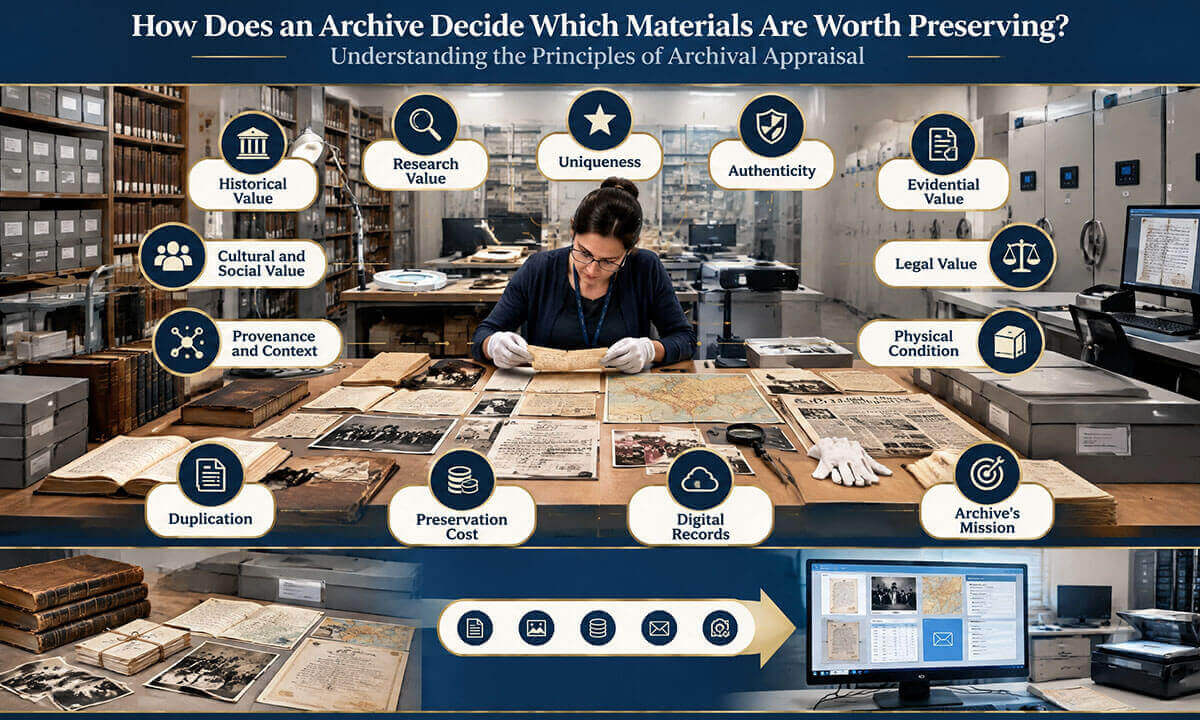
Archivists examine the content, origin, context, uniqueness, condition, and potential usefulness of records. They also consider the archive’s purpose and collecting policy.
Appraisal is necessary because preserving records requires space, money, staff, technology, and continuous maintenance. A careful selection process allows archives to focus their resources on materials with enduring value.
1. Historical Value: Historical significance is an essential consideration when selecting archival materials.
Records that document indispensable events, institutions, communities, organizations, or social changes may have lasting value. For example, records related to the development of a university can help future researchers understand how the institution changed over time.
Historical value is not limited to famous events. Ordinary records can also provide valuable evidence about everyday life, education, employment, family relationships, and communities.
2. Research Value: Archives are necessary sources for researchers. Archivists therefore consider whether records may support future research.
Researchers in history, sociology, education, economics, anthropology, political science, and other fields often depend on archival collections.
A school register, personal diary, organizational report, photograph, or collection of letters may provide information that cannot easily be found elsewhere.
3. Uniqueness: If an archive already has many identical copies of a document, there may be little reason to preserve every copy. In contrast, an original manuscript, photograph, diary, letter, map, or dataset may have significant value because it may be the only surviving example.
Archivists therefore ask whether the material exists elsewhere and whether its loss would result in the permanent loss of important information.
4. Authenticity: Archivists also consider whether a record is authentic and trustworthy.
They examine who created the record, when it was created, why it was created, and whether it has been changed.
Authenticity is particularly important for government, legal, institutional, and historical records.
Digital materials require additional attention because electronic files can easily be copied or modified. Information about the origin and history of a digital record can help archivists establish its authenticity.
5. Evidential and Informational Value: Records can have value because they provide evidence about the activities of their creators.
For example, organizational records can show how an institution was established, managed, and developed. Meeting minutes, policies, reports, and official correspondence can document important decisions and activities.
Records may also contain valuable information about people, places, events, and communities. Census records, university records, photographs, and local documents are examples of materials that can have significant informational value.
6. Cultural and Social Value: Archives also preserve cultural memory. Records can document traditions, languages, customs, community activities, artistic work, social movements, and the experiences of different groups.
Preserving records from different communities is important because historical collections can become incomplete when only powerful institutions or well-known individuals are represented.
A small local collection may therefore be highly valuable if it documents a vital part of a community’s history.
7. Provenance and Context: Archivists consider the provenance of records, meaning their origin or source.
Knowing who created a record and the circumstances in which it was created helps researchers understand its meaning.
Context is equally important. A single letter may appear unimportant when viewed alone, but it may become highly valuable when preserved as part of a larger collection of correspondence.
For this reason, archivists often preserve groups of related records rather than treating every document as an isolated item.
8. Legal and Administrative Value: Some records have legal or administrative value. Examples include contracts, property records, official policies, institutional decisions, legal agreements, and documents relating to rights and responsibilities.
Not every administrative record needs permanent preservation. Some are required only for a specific period. However, records that document important legal or institutional history may deserve long-term preservation.
9. Physical Condition: The condition of a record can also influence preservation decisions. Damaged materials are not necessarily worthless. In fact, a damaged document may contain extremely important information and may require urgent conservation.
Archivists consider whether the material can be stabilized, whether it requires special treatment, and whether its preservation is practical.
They also consider whether the information exists in another reliable form.
10. Duplication: Archives often receive duplicate records. An organization may have several copies of the same report, publication, photograph, or circular. Preserving every copy may not be necessary.
However, archivists must examine duplicates carefully. An original document may have value that a photocopy does not. Two apparently similar records may also have different contexts.
Therefore, duplication is considered together with authenticity, provenance, and research value.
11. Cost and Resources: Preservation requires resources. Archives need storage space, conservation facilities, trained staff, digital storage, security systems, equipment, and maintenance.
Some materials require expensive conservation or specialized technology. Archivists therefore consider whether the value of a record justifies the resources required to preserve it.
This does not mean that expensive materials are automatically rejected. Rather, preservation resources must be managed responsibly.
12. Digital Records: Digital records have become an important part of modern archives. These include emails, websites, databases, digital photographs, videos, electronic documents, social media records, and research data.
Digital preservation creates special challenges. Files can become unreadable when software or hardware becomes obsolete. Storage devices can also fail, and important metadata can be lost.
Archivists therefore consider the file format, metadata, authenticity, accessibility, and long-term preservation requirements of digital materials.
13. The Archive’s Mission: Every archive has a particular purpose. A national archive may focus on government records. A university archive may collect institutional records, faculty papers, student materials, and documents relating to academic development. A local archive may focus on the history of a particular community.
Therefore, a record’s value partly depends on how well it fits the archive’s collecting mission and existing collections.
In conclusion, archives cannot preserve every record that is created. Archival appraisal helps them identify materials with enduring value.
Archivists consider many factors, including historical significance, research value, uniqueness, authenticity, evidential and informational value, cultural importance, provenance, context, legal value, condition, duplication, preservation costs, and the archive’s collecting mission.
The goal is not simply to preserve old documents. It is to preserve meaningful evidence that can help future generations understand people, institutions, communities, events, and society.
In this way, archival appraisal plays a crucial role in protecting collective memory and ensuring that valuable information remains available for future research.

is an experienced educator and academic currently serving as a Lecturer at Nurul Amin Degree College. With a career dedicated to student development and institutional excellence, he brings a wealth of classroom expertise and pedagogical knowledge to his current role. Before joining the faculty, he served as an Assistant Teacher at Zinzira PM Pilot School and College.