Understanding Related Terms (RT) in Library and Information Science:
In Library and Information Science (LIS), organizing information is essential for helping users locate the materials they need quickly and accurately. Libraries contain millions of books, journals, reports, digital resources, and other information sources covering countless subjects. If these resources were organized without a logical system, finding relevant information would become extremely difficult. This is why librarians use controlled vocabularies, subject headings, thesauri, and indexing systems to ensure consistency in describing information resources. One important concept used in these knowledge organization systems is Related Term (RT). Related Terms help connect subjects that are closely associated but do not have a direct hierarchical relationship. They guide users toward additional topics that may be useful during their search. Instead of limiting users to a single subject heading, Related Terms expand the search process by introducing concepts that are connected in meaning or context. Whether someone is searching a library catalogue, an online database, or a digital repository, Related Terms improve information retrieval by revealing additional paths to relevant information. In the rest of this article, we will explore understanding Related Terms (RT) in Library and Information Science.
What is a Related Term (RT)?
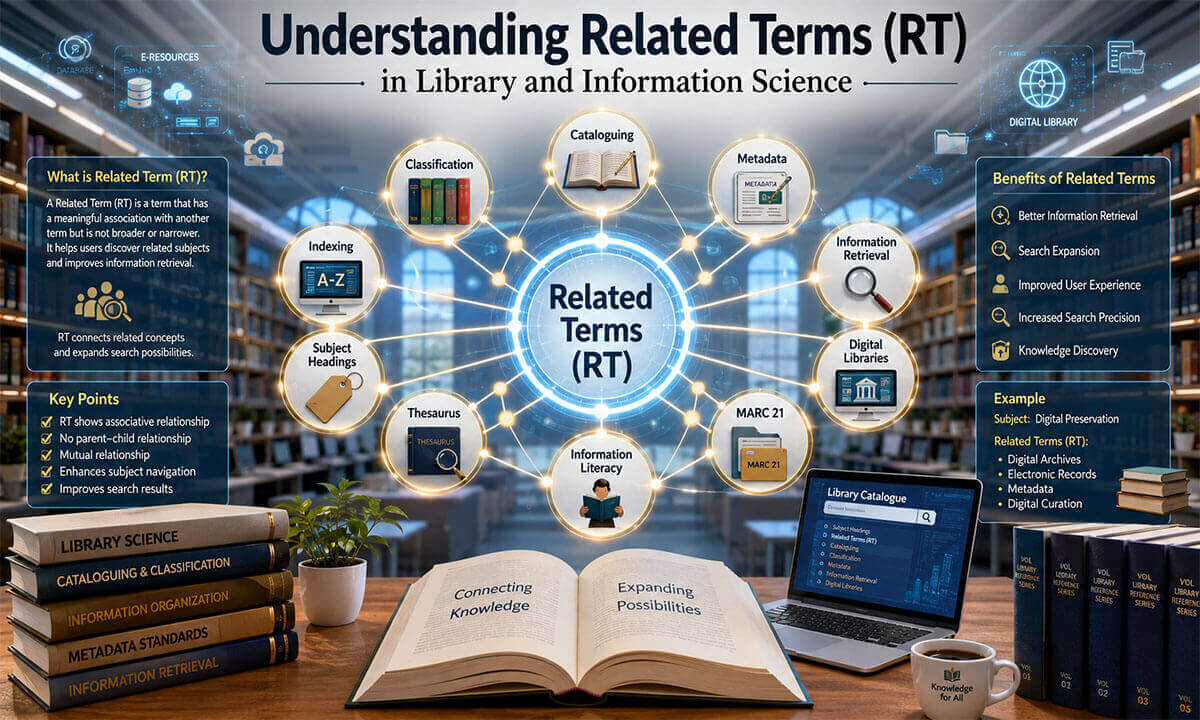
A Related Term (RT) is a subject heading or descriptor that has a meaningful association with another term but does not represent a broader or narrower relationship. Instead, it indicates that two concepts are connected because they share a logical, practical, or conceptual relationship.
In controlled vocabularies and thesauri, RT helps users discover additional subjects that may be relevant to their information needs.
Simply, we can say: “A Related Term (RT) is a term that points users to another subject that is connected in meaning or context but is neither broader nor narrower than the original subject.”
For example:
Artificial Intelligence
RT: Machine Learning
Artificial Intelligence includes many technologies, while Machine Learning is closely connected to it. However, one is not simply broader or narrower than the other in every context, making RT the appropriate relationship.
Purpose of Related Terms:
The primary purpose of Related Terms is to improve information discovery.
They help users:
- Find additional relevant resources.
- Expand their search beyond one subject.
- Understand connections between different concepts.
- Improve the completeness of literature searches.
- Reduce the possibility of missing important information.
Without Related Terms, users might only retrieve resources indexed under one subject heading and overlook many useful materials indexed under related concepts.
Characteristics of Related Terms (RT) in Library and Information Science:
The following are the major characteristics of Related Terms in Library and Information Science.
- Associative Relationship: The most important characteristic of a Related Term is that it represents an associative relationship between two concepts. This means the terms are connected because they share a meaningful relationship, even though one is not broader or narrower than the other.
For example, Cataloguing and Classification are closely related because both are essential processes in organizing library materials. However, cataloguing is not a type of classification, and classification is not a type of cataloguing. Therefore, they are linked as Related Terms.
Example:
Cataloguing
RT: Classification
This relationship helps users understand that both topics are connected and may provide useful information during a search.
- No Hierarchical Relationship: Related Terms do not indicate a hierarchy. Unlike Broader Terms and Narrower Terms, they do not show a parent and child relationship between concepts.
For instance, Digital Libraries and Institutional Repositories are connected because both provide digital access to information resources. However, neither concept includes the other as a broader or more specific category.
Example:
Digital Libraries
RT: Institutional Repositories
This characteristic distinguishes RT from hierarchical relationships used in thesauri and subject heading lists.
- Mutual or Reciprocal Relationship: A Related Term relationship is generally reciprocal. If one concept is related to another, the second concept is also related to the first.
For example:
Information Literacy
RT: Library Instruction
At the same time,
Library Instruction
RT: Information Literacy
This reciprocal structure ensures consistency within controlled vocabularies and allows users to move easily between related concepts.
- Connects Similar or Associated Concepts: Related Terms connect concepts that frequently appear together in the same subject area or discipline. These concepts may support each other, overlap in practice, or be commonly discussed together in academic literature.
For example:
Metadata
RT:
- Cataloguing
- MARC 21
- Dublin Core
- Digital Libraries
Although these concepts are different, they all contribute to the organization and management of information resources.
- Enhances Information Retrieval: One of the primary purposes of Related Terms is to improve information retrieval. They encourage users to search beyond a single subject heading and discover additional relevant resources.
Suppose a student searches for Information Retrieval. The catalogue may suggest the following Related Terms:
- Database Searching
- Search Engines
- Indexing
- Information Seeking Behaviour
These suggestions help users conduct broader and more effective searches.
- Supports Subject Navigation: Related Terms make it easier for users to move from one concept to another during their search process. Instead of reaching a dead end after searching one subject, users can follow related concepts to locate additional information.
For example, a researcher studying Climate Change may also benefit from exploring:
- Global Warming
- Carbon Emissions
- Environmental Policy
- Sustainable Development
This interconnected structure improves navigation within library catalogues and databases.
- Expands Search Results: Another important characteristic of Related Terms is their ability to expand search results. Users often search using one keyword, but relevant information may be indexed under different yet related concepts.
For example, a researcher searching for Artificial Intelligence may also retrieve valuable resources under:
- Machine Learning
- Deep Learning
- Neural Networks
- Expert Systems
Using Related Terms reduces the chances of overlooking important publications.
- Improves Knowledge Discovery: Related Terms encourage users to explore concepts they may not have considered initially. This leads to better knowledge discovery and a deeper understanding of a subject.
For example, someone researching Open Access may discover related topics such as:
- Institutional Repositories
- Scholarly Communication
- Academic Publishing
- Copyright
These related concepts provide a broader perspective on the research topic.
- Represents Different Types of Associations: The relationship between Related Terms can be based on different kinds of associations. These include:
Functional Association: Two concepts work together in practice.
Example:
Cataloguing
RT: Classification
Process Association: One concept supports another during a process.
Example:
Indexing
RT: Abstracting
Subject Association: Two concepts belong to the same academic discipline.
Example:
Digital Libraries
RT: Information Retrieval
Cause and Effect Association: One concept may influence another.
Example:
Information Literacy
RT: Academic Success
These different types of associations make Related Terms flexible and useful in many knowledge organization systems.
- Used in Controlled Vocabularies: Related Terms are widely used in controlled vocabularies to maintain consistency in subject indexing.
They appear in:
- Library Subject Headings
- Thesauri
- Subject Authority Files
- Online Public Access Catalogues (OPACs)
- Bibliographic Databases
- Digital Libraries
- Institutional Repositories
These systems rely on RT relationships to improve subject access and information retrieval.
- Supports Consistent Indexing: Indexers and cataloguers use Related Terms to describe information resources consistently. This ensures that similar materials are connected, even when different subject headings are assigned.
For example, books about Archives may also be connected to:
- Records Management
- Preservation
- Manuscripts
- Cultural Heritage
Such consistency improves the overall quality of library catalogues.
- Helps Users Learn New Vocabulary: Many users may not know the official subject heading used in a library catalogue. Related Terms introduce alternative but connected concepts, helping users become familiar with the vocabulary of a particular discipline.
For example, someone searching for Online Libraries may discover the preferred subject Digital Libraries through Related Terms.
This educational role makes library searching more user friendly, especially for beginners.
- Dynamic and Continuously Updated: Knowledge is constantly evolving, and new concepts emerge regularly. Related Terms are therefore dynamic rather than fixed. Librarians and information professionals periodically update controlled vocabularies to include new technologies, research areas, and interdisciplinary fields.
For example, recent Related Terms connected with Artificial Intelligence now include:
- Generative AI
- Large Language Models
- Prompt Engineering
- Explainable AI
Regular updates keep library systems current and relevant.
- Improves User Experience: Related Terms make searching more intuitive and efficient. Instead of requiring users to know every possible keyword, library systems provide helpful suggestions that guide them toward additional relevant resources.
This feature reduces frustration, saves time, and increases user satisfaction when searching library catalogues and academic databases.
- Encourages Comprehensive Research: Researchers conducting literature reviews need to identify all relevant publications on a topic. Related Terms help them broaden their search strategy by introducing connected concepts that may contain additional evidence.
For example, a researcher studying Mental Health may also search:
- Psychological Wellbeing
- Depression
- Anxiety
- Emotional Health
- Stress Management
As a result, the literature review becomes more comprehensive and balanced.
Related Terms in a Thesaurus:
A thesaurus generally contains three major relationships:
|
Relationship |
Meaning |
| Broader Term (BT) | More general concept |
| Narrower Term (NT) | More specific concept |
| Related Term (RT) | Associated concept |
Example:
Information Literacy
BT: Education
NT: Digital Information Literacy
RT: Library Instruction
Here, Library Instruction is related because it supports information literacy but is not a broader or narrower concept.
Examples of Related Terms:
Example 1: Libraries
RT:
- Librarians
- Information Centers
- Archives
- Digital Libraries
Example 2: Cataloguing
RT:
- Metadata
- Classification
- MARC 21
- Resource Description
Example 3: Children’s Literature
RT:
- Reading Promotion
- School Libraries
- Storytelling
- Early Childhood Education
Example 4: Information Retrieval
RT:
- Search Engines
- Indexing
- Database Searching
- Information Seeking Behaviour
Example 5: Academic Libraries
RT:
- Higher Education
- Research Support
- Institutional Repositories
- Scholarly Communication
Difference Between RT, BT, and NT:
Understanding the difference between Related Terms, Broader Terms, and Narrower Terms is essential.
|
Feature |
BT | NT |
RT |
| Relationship | General to specific | Specific to general | Associated concepts |
| Hierarchical | Yes | Yes | No |
| Parent Child Relationship | Yes | Yes | No |
| Purpose | Move upward | Move downward | Explore related subjects |
Example: Library Automation
BT: Libraries
NT: RFID Systems
RT: Integrated Library Systems
Related Terms in Library Catalogues:
Modern library catalogues often display Related Terms automatically.
For example:
Subject: Digital Preservation
Related Terms:
- Digital Archives
- Electronic Records
- Metadata
- Digital Curation
A user searching only “Digital Preservation” may discover additional resources by following the above related subjects.
Related Terms in Database Searching:
Academic databases also use Related Terms.
Suppose a researcher searches for: Mental Health
The database may recommend:
- Psychological Wellbeing
- Depression
- Anxiety
- Stress Management
- Emotional Health
These suggestions improve search effectiveness and increase the number of relevant research articles retrieved.
Benefits of Related Terms:
Related Terms provide numerous advantages. Some of them are being:
- Better Information Retrieval: Users retrieve more relevant documents because they search multiple connected concepts.
- Improved Search Expansion: Researchers discover additional keywords for literature reviews.
- Enhanced User Experience: Users receive helpful suggestions instead of reaching dead ends.
- Increased Search Precision: Related concepts help users refine or broaden their search appropriately.
- Better Knowledge Discovery: RT relationships reveal hidden connections between different fields of knowledge.
Challenges of Using Related Terms:
Although Related Terms are valuable, they also present some challenges.
- Ambiguous Relationships: Some concepts may be related in different ways, making it difficult to decide whether RT is appropriate.
- Inconsistency: Different thesauri may assign different Related Terms for the same concept.
- Overuse: Too many Related Terms can confuse users by presenting an overwhelming number of choices.
- Maintenance: Controlled vocabularies require regular updates to include new concepts and emerging disciplines.
Importance of Related Terms in Digital Libraries:
Digital libraries contain vast collections of electronic resources. Related Terms make navigation easier by connecting similar topics across different collections.
For example, a student searching for Cybersecurity may also be guided to:
- Information Security
- Network Security
- Data Privacy
- Ethical Hacking
This interconnected approach increases the likelihood of finding comprehensive and relevant information.
Best Practices for Librarians:
Librarians should:
- Use standardized controlled vocabularies.
- Establish clear associative relationships.
- Avoid unnecessary or weak RT connections.
- Review Related Terms regularly.
- Follow international cataloguing and indexing standards.
- Update authority records as new concepts emerge.
These practices improve consistency and enhance the overall quality of library services.
In conclusion, Related Terms (RT) are a vital component of knowledge organization in Library and Information Science. They create meaningful links between concepts that are closely associated but do not have a broader or narrower relationship. By guiding users to related subjects, RT enhances information retrieval, broadens literature searches, and supports more effective exploration of library collections.
In today’s digital information environment, where users expect fast and comprehensive access to knowledge, Related Terms play an increasingly important role in connecting ideas across disciplines. They enrich library catalogues, online databases, and digital repositories by encouraging users to explore beyond a single subject heading. For librarians, cataloguers, indexers, and researchers, understanding and applying Related Terms correctly improves the organization, accessibility, and discoverability of information resources. As libraries continue to evolve with advances in technology and knowledge organization, the effective use of Related Terms will remain essential for delivering accurate, efficient, and user-centered information services.

is an experienced educator and academic currently serving as a Lecturer at Nurul Amin Degree College. With a career dedicated to student development and institutional excellence, he brings a wealth of classroom expertise and pedagogical knowledge to his current role. Before joining the faculty, he served as an Assistant Teacher at Zinzira PM Pilot School and College.