Archives: Meaning, Types, Importance, Functions and Role in Library and Information Science
Archives are an essential part of the information environment. They preserve records and documents that have lasting value for individuals, organizations, communities, governments, researchers, and society. While libraries mainly collect published materials for reading and research, archives often preserve original records created or received during the activities of a person or organization.
Letters, manuscripts, photographs, maps, government records, institutional documents, personal papers, audio recordings, videos, electronic files, and other historical materials can all become archival records when they have continuing value.
Archives help us understand the past and support present-day research. They also provide evidence of decisions, activities, events, and experiences. In universities, government institutions, businesses, museums, libraries, and cultural organizations, archives can therefore serve both administrative and historical purposes.
The growth of digital technology has also changed archival work. Many institutions now create digital records, digitize older materials, develop digital repositories, and provide online access to archival collections. Digital technologies have expanded access, but they have also created new challenges related to preservation, storage, authenticity, security, and long-term access.
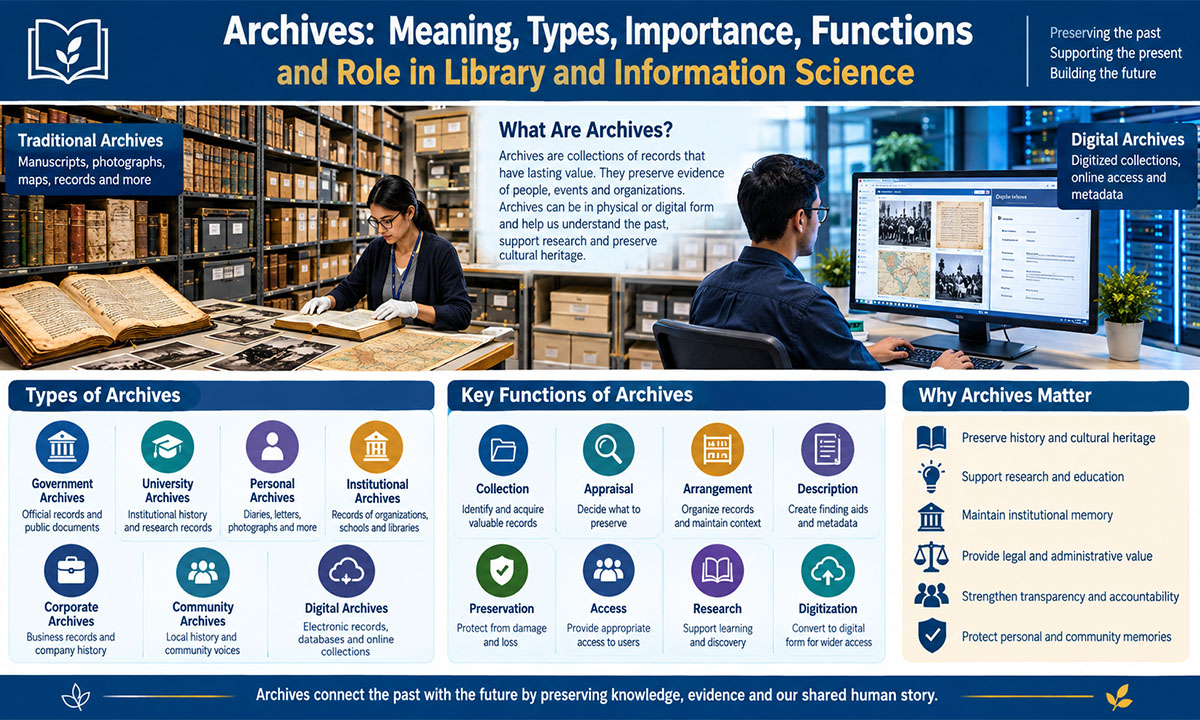
What Are Archives?
The term “archives” can refer to both the records that have been preserved and the institution responsible for preserving those records.
In a broad sense, archives are collections of records that are kept because they have continuing administrative, legal, historical, cultural, or research value.
Archival records are usually connected to the activities of the person, family, organization, institution, or government that created or received them. This relationship with their original creator is one of the important characteristics that distinguishes archives from ordinary collections of information.
For example, a university may preserve:
- Meeting minutes
- Annual reports
- Administrative correspondence
- Student publications
- Photographs
- Institutional policies
- Historical documents
- Architectural plans
- Records of important events
These records can help future researchers understand how the university developed over time.
Meaning of Archives in Library and Information Science:
In Library and Information Science, archives are concerned with the systematic identification, collection, arrangement, description, preservation, and provision of access to records that have enduring value.
Archives are not simply old documents stored in a room. A record does not become valuable merely because it is old. Its value may come from its evidence, uniqueness, historical significance, legal importance, cultural meaning, or usefulness for research.
Archival work therefore involves professional decisions about which records should be preserved, how they should be organized, how they should be protected, and how users can access them.
Characteristics of Archives:
Archives have several characteristics; some of them are given below:
- They preserve evidence: Archives provide evidence about activities, decisions, events, people, and institutions. This evidence can be valuable for administration, legal purposes, historical research, and social studies.
- They have continuing value: Not every record needs to be kept permanently. Archives normally preserve records that have continuing value beyond their original administrative purpose.
- They maintain relationships between records: Archival records are often understood in relation to the activities and functions that produced them. Maintaining these relationships can help researchers understand the context of the records.
- They may contain unique materials: Many archival materials are unique or exist in only a few copies. A historical letter, original manuscript, photograph, institutional record, or personal diary may have no equivalent elsewhere.
- They can support research: Archives provide primary sources for researchers in history, education, sociology, political science, anthropology, literature, economics, library science, and many other disciplines.
- They can exist in different formats: Archives are not limited to paper. They may include photographs, maps, films, audio recordings, videos, microforms, databases, emails, websites, and other digital materials.
Types of Archives:
Archives can be classified in different ways depending on their ownership, purpose, content, and users.
1. Government Archives: Government archives preserve records created by government departments and public institutions.
These records may include legislation, administrative records, official correspondence, census materials, reports, maps, court records, and other government documents.
Government archives can support transparency, accountability, historical research, and public administration.
2. Institutional Archives: Institutional archives preserve records created by organizations such as universities, schools, hospitals, professional organizations, libraries, religious institutions, and businesses.
For example, a university archive may preserve records that document the history and development of the institution.
3. University Archives: University archives are specialized collections that preserve records related to the history and administration of universities.
They may contain:
- University calendars
- Annual reports
- Examination records
- Administrative documents
- Photographs
- Student newspapers
- Faculty publications
- Institutional correspondence
- Historical manuscripts
- Records of important university events
University archives are particularly useful for institutional research and academic studies.
4. Personal Archives: Personal archives contain records created or collected by individuals or families.
Examples include:
- Diaries
- Personal letters
- Family photographs
- Certificates
- Personal manuscripts
- Memoirs
- Personal correspondence
- Digital photographs
- Emails
Personal archives can provide valuable information about individual experiences and social history.
5. Corporate Archives: Corporate archives preserve records related to companies and business organizations.
These may include company reports, advertising materials, product records, photographs, correspondence, financial documents, and records of major organizational decisions.
Corporate archives can help organizations understand their history and preserve institutional knowledge.
6. Religious Archives: Religious organizations may maintain archives containing records of congregations, institutions, leaders, activities, publications, photographs, and historical events.
These materials can be valuable for studying religious, social, cultural, and community history.
7. Community Archives: Community archives preserve records related to particular communities, groups, neighborhoods, or social movements.
They can help preserve local history and voices that may not be adequately represented in large national or institutional collections.
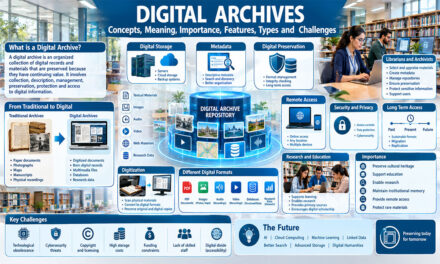
8. Digital Archives: Digital archives contain records that are stored and managed in digital form.
They may include digitized historical documents as well as records that were originally created digitally.
Examples include:
- Digitized manuscripts
- Digital photographs
- Electronic reports
- Emails
- Websites
- Digital audio
- Digital video
- Electronic publications
- Institutional digital records
Digital archives can make historical and research materials available to users without requiring them to physically visit an archival institution.
Research on digital archival collections has emphasized that digitization can increase access to documentary heritage, although digital preservation also creates technical and financial challenges.
Archives and Libraries:
Archives and libraries are closely related, but they are not the same.
Libraries generally collect published or organized information resources for use by a broad group of users. Books, journals, newspapers, databases, and other published resources are common library materials.
Archives, on the other hand, often preserve original records created or received by individuals and organizations as part of their activities.
There can still be significant overlap. Libraries may maintain archival collections, and archives may provide access to published materials that support research.
The major difference is often related to the nature and context of the materials.
A library might have several copies of a published history book. An archive might preserve the original letters, photographs, research notes, and unpublished documents used to write that history.
Importance of Archives:
Archives have considerable importance in education, research, administration, culture, and society.
- Preservation of History: Archives preserve records that document the past. Without systematic preservation, many important records could disappear.
- Support for Research: Researchers use archival materials as primary sources. These sources can provide information that may not be available in textbooks or secondary publications.
- Institutional Memory: Organizations can use archives to understand their own development. Historical records can show how policies, services, structures, and activities changed over time.
- Legal and Administrative Value: Some records need to be preserved because they provide evidence of ownership, decisions, agreements, rights, responsibilities, and official activities.
- Cultural Heritage: Archives can preserve the cultural heritage of communities and nations. Photographs, manuscripts, oral histories, maps, and personal records can document language, traditions, social life, and cultural change.
- Support for Education: Teachers and students can use archival materials to make learning more connected to original evidence. Historical documents can help students understand events from primary sources.
- Accountability and Transparency: Institutional and government records can help demonstrate how decisions were made and how organizations operated.
- Preservation of Personal and Community Memories: Archives can preserve experiences that may otherwise disappear from collective memory.
Functions of Archives:
Archives perform several central functions; some of them are mentioned below:
- Collection: Archives identify and acquire records that have long-term value.
- Appraisal: Appraisal involves determining which records have sufficient value to be preserved permanently or for a specified period.
- Arrangement: Archival materials need to be organized in a meaningful way. Proper arrangement helps preserve relationships among records and makes them easier to understand.
- Description: Archivists create descriptions and finding aids that help users discover relevant materials.
- Preservation: Preservation protects records from physical deterioration, environmental damage, technological obsolescence, and other threats.
- Access: Archives provide appropriate access to collections while respecting privacy, copyright, security, confidentiality, and other restrictions.
- Reference Services: Archivists assist researchers in identifying and using relevant archival materials.
- Digitization: Institutions may digitize selected archival materials to improve access and reduce unnecessary handling of fragile originals.
Archival Materials:
Archives can contain a wide range of materials.
- Paper Records: These include letters, reports, minutes, manuscripts, registers, certificates, newspapers, and administrative documents.
- Photographs: Historical photographs can document people, buildings, events, communities, and social changes.
- Maps and Plans: Maps can provide information about geographical, political, architectural, and environmental changes.
- Audio Records: Interviews, speeches, oral histories, music, and other recordings may become important archival materials.
- Audiovisual Records: Films and videos can document historical events, cultural activities, educational programs, and institutional activities.
- Digital Records: Modern archives increasingly preserve electronic records such as emails, databases, websites, digital photographs, documents, and multimedia files.
Archival Arrangement and Description:
One of the major responsibilities of an archive is to make its collections understandable and discoverable.
Unlike a simple storage system, archival arrangement considers the relationship between records and their creator.
Archivists may organize records into different levels, such as:
- Repository
- Collection
- Series
- File
- Item
Finding aids and descriptive records can then help researchers understand what a collection contains and how the materials are organized.
Good description is especially important for large collections because users cannot examine every individual record before deciding which materials they need.
Preservation of Archives:
Preservation is one of the central responsibilities of archival institutions.
Physical records can be damaged by:
- High temperature
- High humidity
- Water
- Fire
- Dust
- Insects
- Mold
- Poor handling
- Light
- Acidic paper
- Natural deterioration
Archives therefore require appropriate environmental conditions, storage facilities, handling procedures, security measures, and disaster planning.
Preservation also applies to digital records.
Digital materials can become inaccessible when file formats, hardware, software, or storage technologies become obsolete. Long-term digital preservation therefore requires planned management of files, metadata, storage systems, formats, backups, and access technologies.
Digital Archives:
The development of information and communication technology has significantly changed archival practice.
Digital archives can provide access to materials through online platforms. A researcher may be able to examine a digitized manuscript or photograph from another country without physically visiting the archive.
Digitization can therefore increase the visibility and accessibility of archival collections.
However, digitization does not mean that preservation problems disappear. Digital files require ongoing management. Institutions also need sufficient storage capacity, technical expertise, funding, security, metadata, backup systems, and preservation strategies.
Research on digital archives has also noted that digitized collections can create new opportunities for connecting documents, metadata, databases, online exhibits, and other digital research resources.
Archives and Information Technology:
Information technology has become an important part of modern archival management.
Technology can support:
- Digital cataloguing
- Collection management
- Metadata creation
- Digitization
- Optical character recognition
- Digital preservation
- Online discovery
- Digital repositories
- Remote access
- Backup and recovery
- User services
Artificial intelligence and other emerging technologies may also support activities such as text recognition, image analysis, transcription, metadata generation, and information discovery. However, these technologies require careful human oversight because archival records can contain complex historical and cultural contexts.
Challenges of Archives:
Archives face numerous challenges; some of them are given below:
- Limited Funding: Preservation, digitization, storage, staffing, and technological infrastructure can require substantial financial resources.
- Lack of Skilled Personnel: Archivists require knowledge of appraisal, arrangement, description, preservation, records management, digital technologies, and information services.
- Physical Deterioration: Old records may become fragile and difficult to handle.
- Digital Preservation: Digital records can become inaccessible because of obsolete formats, software, hardware, or storage systems.
- Large Volumes of Records: Modern organizations create enormous amounts of information. Archives must determine what should be preserved and what can eventually be disposed of.
- Privacy and Confidentiality: Archival records may contain personal or sensitive information. Institutions must establish appropriate access restrictions and privacy practices.
- Copyright: Digitizing and providing online access to archival materials can raise copyright questions.
- Security: Archives must protect valuable records against theft, unauthorized alteration, accidental destruction, cyber threats, and other risks.
- Digital Divide: Online access can expand the reach of archives, but users still need suitable devices, internet access, and digital skills.
Role of Archivists:
Archivists are professionals responsible for managing records with enduring value.
Their work can include:
- Identifying valuable records
- Appraising records
- Acquiring archival materials
- Arranging collections
- Describing materials
- Preserving physical records
- Managing digital records
- Creating finding aids
- Providing reference services
- Supporting researchers
- Managing digitization projects
- Developing access policies
The role of the archivist is becoming increasingly technological. Modern archivists may need skills in digital preservation, metadata, databases, digitization, electronic records management, and online information services.
Archives in Research and Education:
Archives are particularly valuable in research because they can provide primary evidence.
For example, a researcher studying the history of an educational institution may examine:
- Original meeting minutes
- Historical photographs
- Student publications
- Institutional correspondence
- Annual reports
- Policy documents
- Personal papers of important individuals
These materials can provide information about how an institution actually developed rather than relying only on later summaries.
Students can also benefit from archival education. Working with original records can encourage critical thinking, source evaluation, historical interpretation, and research skills.
Archives in the Digital Age:
The digital age has created both opportunities and responsibilities for archival institutions.
Traditional archives focused heavily on paper documents and physical preservation. Modern archives must also deal with email, websites, databases, social media content, electronic documents, digital photographs, video, and other forms of born digital information.
Digital access can make archives available to a much wider audience. At the same time, institutions need long-term strategies to ensure that digital materials remain authentic, usable, secure, and accessible.
Digitization should therefore be viewed as part of a broader preservation and access strategy rather than simply as the process of scanning documents.
Future of Archives:
The future of archives will increasingly involve a combination of traditional archival principles and digital technologies.
Archives are likely to expand their use of:
- Digital repositories
- Cloud-based infrastructure
- Artificial intelligence
- Automated transcription
- Optical character recognition
- Linked data
- Digital preservation systems
- Online exhibitions
- Remote research services
- Advanced search systems
- Digital humanities tools
At the same time, the fundamental purpose of archives will remain the same: preserving records that have continuing value and making them available for appropriate use.
Technology may change how archives are managed and accessed, but professional judgment, context, authenticity, preservation, and responsible access will remain essential.
In conclusion, archives are indispensable for preserving documentary heritage and supporting research, education, administration, accountability, and cultural memory. They contain records that can help individuals and communities understand their history and help organizations maintain knowledge of their development.
Archives can include traditional paper documents, photographs, maps, manuscripts, audio recordings, films, and increasingly large collections of digital records. Their effective management requires careful collection, appraisal, arrangement, description, preservation, and access.
Digital technology has created new possibilities for archival access. Researchers can increasingly discover and use materials from distant locations through online collections and digital repositories. At the same time, digital preservation, privacy, copyright, security, funding, and technological change create important challenges.
For Library and Information Science professionals, understanding archives is therefore increasingly important. Archives are not simply places where old documents are stored. They are organized systems for preserving evidence, memory, knowledge, and cultural heritage for present and future generations.

is an experienced educator and academic currently serving as a Lecturer at Nurul Amin Degree College. With a career dedicated to student development and institutional excellence, he brings a wealth of classroom expertise and pedagogical knowledge to his current role. Before joining the faculty, he served as an Assistant Teacher at Zinzira PM Pilot School and College.