How to Avoid Lifestyle Inflation After Your First Job: 10 Smart Steps
Landing your first job is an incredible feeling. After years of living on tight student budgets, part-time shifts, or parental allowances, seeing that first steady paycheck hit your bank account feels like a massive victory. Suddenly, you have financial independence—and with it, the urge to finally buy all the things you had to put off for years. It starts innocently enough: grabbing takeout a few extra nights a week, upgrading your phone, or eyeing a nicer apartment. But if you aren’t careful, your spending will naturally rise to match your new income—a phenomenon known as lifestyle inflation (or “lifestyle creep”). If left unchecked, lifestyle creep can trap you in a cycle where you earn more, but never actually feel wealthier. Here is a practical guide on how to avoid lifestyle inflation after your first job: 10 smart steps.
What Is Lifestyle Inflation?
Simply put, lifestyle inflation is when your spending increases right alongside your income.
When you make more money, your standard of living “inflates” to match it. Instead of saving or investing the extra cash, you slowly upgrade your life:
In college or your first job: You lived with roommates, cooked basic meals at home, drove an old reliable car, and brewed your own coffee.
After a raise or new job: You move into a pricier solo apartment, start ordering takeout four nights a week, buy a brand-new car with a monthly payment, and grab a $6 daily latte without thinking twice.
[Salary Increases] —> [Spending Upgrades] —> [Savings Stay the Same]
Notice that none of these purchases are inherently bad! You worked hard, so upgrading your life feels completely normal and justified. You tell yourself, “I can afford this now.”
The problem is that your expenses grow at the exact same speed as your paycheck, leaving you with the same amount of savings you had when you were making less money.
Why Does It Happen? (The Human Psychology)
Lifestyle inflation isn’t usually caused by reckless spending sprees. Instead, it’s driven by subtle human psychology:
- The “I Deserve This” Mindset: When you work long hours or land a big achievement, it’s natural to want a reward. You feel like you’ve earned the right to buy nicer clothes, go to pricier restaurants, or live in a fancier neighborhood.
- The Hedonic Treadmill: This is a psychological concept that explains how humans adapt to new situations. When you upgrade your life (say, buying a bigger TV) it feels exciting for a week or two. But very quickly, that new TV becomes your “new normal.” The excitement wears off, so you look for the next upgrade to get that same happy feeling again.
- Peer Pressure & Comparison: As your career progresses, you often spend time around people who earn more money. When colleagues go out for expensive lunches, drive sleek cars, or take luxurious vacations, it’s easy to feel like you need to do the same just to fit in.
Why Does Lifestyle Inflation Matter So Much?
You might be thinking: “If I’m earning the money and paying my bills, why does it matter if I spend it?”
It matters because earning more money doesn’t automatically make you wealthier—saving and investing it does. Here is why uncontrolled lifestyle creep can derail your life:
- You Stay Stuck on the “Paycheck-to-Paycheck” Cycle: If your expenses rise to meet your income, your financial safety cushion never grows. A person earning $100,000 a year who spends $100,000 is just as financially vulnerable as someone earning $40,000 who spends $40,000. If an unexpected emergency happens (like a job loss, medical bill, or car breakdown) you’ll still struggle to cover it.
- You Miss Out on Compound Interest: The money you earn in your 20s, 30s, and 40s has massive growth potential if you invest it. Because of compound interest (earning interest on top of interest), every dollar you invest today can multiply several times over by the time you retire.
Example: If you get a $500/month raise and immediately spend it on a nicer car payment, that money is gone forever. But if you invest that $500/month at an average 7% return, it could grow into over $260,000 in 20 years.
- It Raises Your “Baseline” for Happiness: The more expensive your lifestyle becomes, the harder it is to scale back if things go wrong. If you get used to fine dining, luxury apartments, and premium subscriptions, taking a pay cut or switching to a lower-paying job you actually love feels painful. High fixed expenses trap you in jobs you might dislike simply because you have to pay the bills.
- It Delays Your Financial Freedom: Financial freedom isn’t about having luxury items; it’s about having options. It’s the ability to take a gap year, start a business, care for a family member, or retire comfortably. When you pour all your extra income into temporary lifestyle upgrades, you trade away your long-term independence for short-term comfort.
10 Smart Ways to Avoid the Lifestyle Trap:
Once your income starts going up, keeping your spending under control is easier said than done. The impulse to treat yourself is strong, and before you know it, that extra money vanishes into monthly subscriptions, nicer dinners, and impulse purchases. Avoiding the “lifestyle trap” doesn’t mean living on instant noodles forever or denying yourself every reward. It’s about being intentional—making sure your money goes toward things that truly build a secure, happy life rather than slipping away on things you’ll forget about next week. Here is a brief, real-world breakdown of 10 smart strategies to keep lifestyle inflation in check.
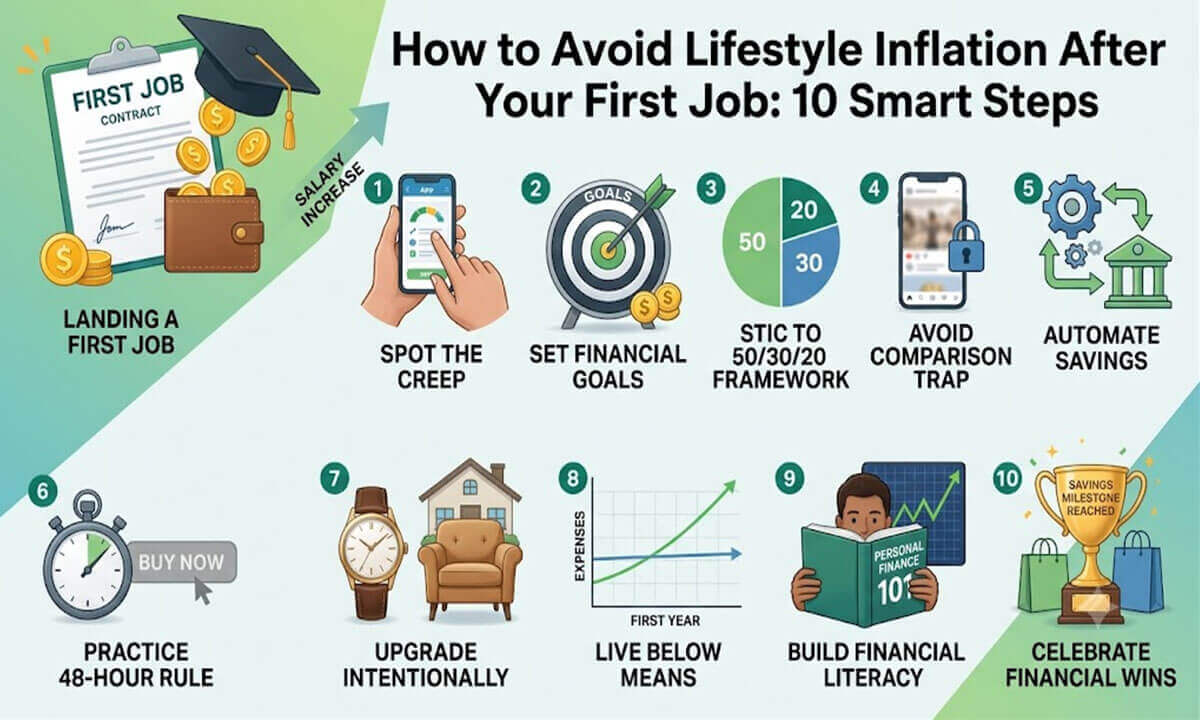
1. Spot the “Creep” Early (Before It Becomes a Habit): Lifestyle inflation doesn’t happen all at once; it creeps up in tiny, almost invisible steps. You start ordering takeout three nights a week instead of one. You buy the $6 latte daily instead of brewing coffee at home. You upgrade to the premium tier on all your streaming services.
Individually, these small purchases seem harmless. But added together, they quickly eat up hundreds of dollars a month.
How to do it: For just one month, track every single dollar you spend using a simple spreadsheet or budgeting app. Don’t judge yourself or cut back yet—just observe. You will likely spot several small, mindless upgrades that aren’t actually bringing you joy but are draining your account.
2. Give Every Dollar a Purpose with Clear Goals: When extra money sits in a checking account without a clear purpose, your brain treats it as “free cash” waiting to be spent. To stop aimless spending, you need to assign that money a specific job before you have the chance to spend it.
How to do it: Define concrete financial milestones. Instead of saying, “I want to save more,” set clear targets like:
- “I am building a $5,000 emergency fund.”
- “I am saving $3,000 for a trip to Japan next summer.”
- “I am paying off $200 of my credit card debt each month.”
When your money already has an important job to do, skipping an impulse buy doesn’t feel like a sacrifice—it feels like a conscious choice to fund your own goals.
3. Use the 50/30/20 Framework to Keep Balance: Budgeting gets a bad reputation because people assume it means giving up everything fun. A realistic budget actually gives you permission to spend money on things you love—as long as your basic needs and future savings are covered first.
A great benchmark is the 50/30/20 Rule:
|
Category |
Target % |
What It Covers |
|
Needs |
50% |
Rent, groceries, utility bills, health insurance, minimum debt payments |
|
Wants |
30% |
Dining out, entertainment, hobbies, travel, shopping |
|
Savings & Growth |
20% |
Emergency fund, retirement accounts, investments, extra debt payoff |
If a raise pushes your income up, adjust the dollar amounts in each bucket, but keep the percentages stable. That way, your savings grow proportionately with your income.
4. Dodge the Social Media Comparison Trap: It’s human nature to compare ourselves to others, but social media makes this comparison toxic. Scrolling through pictures of acquaintances buying brand-new sports cars, flying first class, or buying designer clothes creates a false sense of what “normal” spending looks like.
What you rarely see on social media is the underlying reality: high credit card debt, empty savings accounts, or financial anxiety behind closed doors.
How to do it: Focus strictly on your own financial journey. If following certain accounts or influencers constantly triggers the urge to buy things you don’t need, hit the mute or unfollow button. Out of sight, out of mind.
5. Put Your Savings on Autopilot: The single most effective way to beat lifestyle creep is to pay yourself first. If you wait until the end of the month to save whatever is left over, the answer is usually $0.
How to do it: Set up automatic recurring transfers from your checking account to your savings or investment accounts on the exact day your paycheck arrives.
By automating your savings, you remove willpower from the equation. You adjust your daily living expenses based only on the money that remains in your checking account, making saving completely effortless.
6. Master the 48-Hour Delay Rule: Impulse buying is driven by emotions, short-term excitement, and clever marketing. Retailers design shopping experiences specifically to get you to buy instantly before your rational brain has time to weigh in.
How to do it: Institute a mandatory 48-hour cool-off period for any non-essential purchase over a set amount (e.g., $50 or $100).
- Add the item to your digital cart or write it down on a list.
- Walk away for two full days.
- If you still desperately want it 48 hours later (and it fits comfortably in your budget) go ahead and buy it.
In reality, the initial emotional rush wears off most of the time, and you’ll completely forget about the item.
7. Upgrade Your Life Intentionally, Not Automatically: Living below your means doesn’t mean you can never enjoy nicer things. As your career progresses, upgrading your quality of life is part of the fun. The key is doing it intentionally rather than upgrading everything by default.
How to do it: Pick one or two areas of life that bring you genuine, lasting joy, and allow yourself to spend more there. Keep your spending low in areas you don’t care as much about.
Example: If you love cooking and entertaining, splurge on high-quality kitchenware and good groceries, but keep driving your paid-off, reliable older car instead of taking on a pricey new car loan.
8. Maintain Your “Low-Expense Baseline” for 6–12 Months: When you get a salary raise, a new job, or a bonus, resist the urge to immediately raise your living standards to match it on day one.
How to do it: Commit to living at your previous spending baseline for just 6 to 12 months after receiving a pay bump.
- Route 100% of the extra income straight into building an emergency buffer, paying off debt, or investing.
Once you have built a solid financial cushion, you can re-evaluate your budget and start slowly upgrading your lifestyle from a position of absolute safety.
9. Boost Your Financial Literacy (Make Money Interesting): When you don’t understand how money works, cash feels like something that exists only to be spent on physical items. But once you learn how investing works, your mindset shifts: you start seeing money as a tool that can buy your freedom and time.
How to do it: Read beginner-friendly personal finance books (like The Psychology of Money by Morgan Housel or I Will Teach You To Be Rich by Ramit Sethi), or listen to finance podcasts during your commute.
Understanding basic concepts like compound interest and index funds makes it much more exciting to invest $100 for your future self than to waste it on a cheap trend today.
10. Celebrate Milestones, Not Just Paychecks: Most people celebrate getting a raise by going out on a shopping spree or booking a lavish dinner. While celebrating wins is important, linking every increase in income to an immediate increase in consumption reinforces bad habits.
How to do it: Shift your celebration triggers from income milestones to wealth milestones.
- Celebrate when your emergency fund hits its target.
- Celebrate when you completely pay off a credit card or student loan.
- Celebrate when your investment account hits its first major benchmark.
Shifting your focus to financial progress turns wealth-building into a rewarding game you actually enjoy playing.
In conclusion, landing your first job is a major achievement, and you deserve to take pride in your new income. But true financial independence isn’t determined by how much money shows up on your paycheck—it’s determined by how much of that money stays in your pocket. By staying mindful of lifestyle inflation, setting clear goals, and automating your savings, you ensure that your salary increase translates into real, lasting wealth rather than temporary upgrades.

is an experienced educator and academic currently serving as a Lecturer at Nurul Amin Degree College. With a career dedicated to student development and institutional excellence, he brings a wealth of classroom expertise and pedagogical knowledge to his current role. Before joining the faculty, he served as an Assistant Teacher at Zinzira PM Pilot School and College.