Digital Archives: Concepts, Meaning, Importance, Features, Types and Challenges
Libraries and archives have always played an important role in collecting, organizing, preserving, and providing access to information. Traditionally, archives depended mainly on physical materials such as manuscripts, letters, photographs, maps, newspapers, reports, books, audio recordings, and other paper-based documents. These materials were stored in physical buildings and were usually accessed by visiting the archive.
The growth of computers, the internet, and digital technologies has changed the way information is created, stored, managed, preserved, and accessed. Today, a large amount of information exists in digital form. Some materials are created digitally from the beginning, while older physical materials are converted into digital formats. This development has created the need for digital archives.
A digital archive is more than a computer folder containing files. It involves the organized collection, description, management, preservation, protection, and provision of access to digital records and other digital materials. A properly managed digital archive aims to ensure that valuable digital information remains authentic, usable, discoverable, and accessible over time. The University of Edinburgh, for example, describes its digital archive as a collection of unique and valuable digital resources selected for long-term preservation because of their evidential, legal, contextual, or informational value.
Digital archives have become increasingly important for universities, libraries, governments, museums, research organizations, businesses, and cultural institutions. They help protect institutional memory and make valuable information available to researchers, students, professionals, and the wider public.
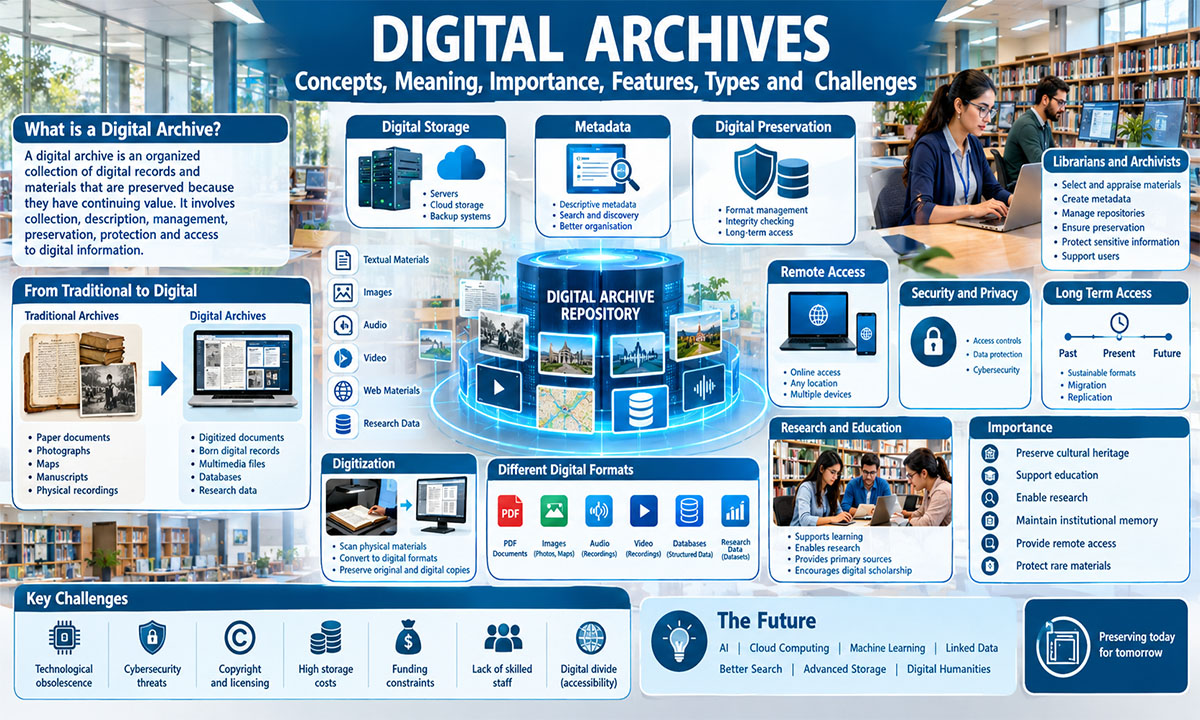
What Is a Digital Archive?
A digital archive can be understood as an organized collection of digital records and materials that are preserved because they have continuing value.
Digital archives can contain materials created originally in digital form as well as materials converted from physical formats. The Library of Congress notes that digital collections can include text, audio, still images, video, digitized materials, and materials that were originally created digitally.
A digital archive therefore brings together several important activities:
- Identifying valuable digital materials
- Selecting materials for preservation
- Acquiring or receiving digital records
- Organizing the materials
- Creating descriptive metadata
- Storing digital objects securely
- Protecting the integrity and authenticity of records
- Preserving materials over time
- Providing appropriate access
- Managing the collection throughout its lifecycle
A digital archive may be available through a public website, an institutional system, a repository, or a restricted internal platform. Access depends on the nature of the collection, copyright, privacy, security, institutional policy, and other legal requirements.
Meaning of Digital Archives:
The basic meaning of a digital archive is closely related to the traditional meaning of an archive. Both are concerned with preserving records that have continuing value.
The major difference is the form of the records and the technology required to manage them.
A traditional archive may contain paper documents, photographs, maps, manuscripts, physical recordings, and other tangible materials. A digital archive may contain PDF files, word processing documents, spreadsheets, databases, photographs, scanned documents, audio files, video files, websites, emails, research data, and other digital objects.
The Office of the State Archivist of Tasmania explains that a digital archive performs a role similar to a traditional archive in the digital environment. It involves technical infrastructure, standards, policies, procedures, and support services for managing and providing access to digital objects and their metadata.
This shows that digital archiving is not simply about storing files. It is a complete management process.
Digital Archive and Digital Preservation:
The terms digital archive and digital preservation are closely related, but they do not mean exactly the same thing.
A digital archive refers to the collection and management environment in which valuable digital records are stored, described, preserved, and made available.
Digital preservation refers to the activities required to keep digital materials accessible and usable over time.
The Digital Preservation Coalition defines digital preservation as a series of managed activities necessary to ensure continued access to digital materials for as long as necessary. It includes actions needed to deal with media failure and technological or organizational change.
In simple terms:
Digital archive = the organized collection and management environment.
Digital preservation = the continuing work required to keep digital materials usable over time.
Digital preservation is an essential part of digital archiving. A digital archive without a preservation strategy may eventually contain files that cannot be opened, understood, or trusted.
What Is a Digital Record?
A digital record is information that is created, received, maintained, or stored in digital form.
Examples include:
- Digital reports
- Emails
- Electronic forms
- Research papers
- Theses and dissertations
- Institutional documents
- Databases
- Digital photographs
- Audio recordings
- Video recordings
- Websites
- Social media records
- Research datasets
- Electronic correspondence
Digital records can be divided into two broad categories.
Born Digital Records: Born digital records are created in digital form from the beginning.
Examples include an email, a digital photograph, a Microsoft Word document, an electronic report, or a database record.
These materials do not necessarily have an equivalent physical original.
Digitized Records: Digitized records are materials that originally existed in physical or analogue form but were converted into digital formats.
For example, a library may scan an old newspaper and create a PDF version. A museum may digitize old photographs. An archive may convert an old audio recording into a digital audio file.
Archives New Zealand distinguishes between born digital records and digitized materials and describes digitization as the process of converting hard copy or non-digital records into digital form.
Main Features of Digital Archives:
Digital archives have several important features that distinguish them from traditional archives.
1. Digital Storage: The most obvious feature is that the materials are stored in digital form. Digital files can be stored on servers, storage systems, cloud platforms, institutional repositories, or other suitable infrastructure.
Digital storage makes it possible to manage large collections without requiring physical shelves for every document.
2. Easy Access: Digital archives can make information available to users without requiring them to visit the physical archive.
Depending on access policies, researchers may be able to search and use materials from different locations through the internet.
This is especially useful for students, researchers, teachers, historians, and professionals who may live far away from the institution holding the original material.
3. Searchability: Digital archives can provide search facilities that help users find specific materials quickly.
Users may search by:
- Author
- Title
- Subject
- Date
- Keyword
- Collection
- File type
- Institution
- Geographic location
- Identifier
Metadata plays a crucial role in making digital collections searchable and discoverable. The Library of Congress identifies metadata as an important part of digital collection management and access.
4. Metadata: Metadata is information that describes a digital object.
For example, metadata for a digital photograph may include:
- Title
- Creator
- Date
- Description
- Subject
- Format
- Rights information
- Identifier
Good metadata helps users understand what a digital object is and helps systems organize and retrieve it.
5. Long-Term Preservation: Digital archives are designed to preserve information for future use.
However, digital preservation is not simply a matter of putting files on a hard drive and leaving them there. Digital materials can become inaccessible because storage media fail, file formats become obsolete, software changes, or organizations lose the resources needed to maintain the collection.
6. Multiple Formats: Digital archives can contain many different types of files.
A single archive may contain text documents, photographs, audio, video, databases, maps, websites, and datasets.
This makes digital archives useful for preserving complex collections.
7. Controlled Access: Not every digital record should necessarily be available to everyone.
Some materials may contain personal information, confidential information, copyrighted content, sensitive institutional information, or legally restricted records.
Digital archives can therefore use different levels of access, including public access, registered user access, restricted access, and closed access.
8. Authenticity and Integrity: An important responsibility of a digital archive is to maintain confidence that a digital record has not been improperly changed.
Preservation systems may use technical controls, metadata, checksums, audit information, documented procedures, and other methods to monitor the integrity and authenticity of digital materials.
The Library of Congress emphasizes that preservation must support access to authentic and accurate copies of digital content.
Types of Materials Found in Digital Archives:
Digital archives can contain a wide variety of information resources.
Textual Materials: These may include:
- Manuscripts
- Letters
- Reports
- Newspapers
- Books
- Theses
- Dissertations
- Meeting minutes
- Government documents
- Research papers
Image Materials: These may include:
- Photographs
- Posters
- Maps
- Drawings
- Artwork
- Scanned documents
- Historical images
Audio Materials: Examples include:
- Interviews
- Oral histories
- Speeches
- Music recordings
- Radio recordings
- Recorded lectures
Video Materials: Examples include:
- Documentaries
- Lectures
- Interviews
- Historical recordings
- Institutional events
- Educational videos
Web Materials: Digital archives can also preserve websites and other web-based resources.
Web content can disappear or change rapidly, so web archiving can be important for preserving information that might otherwise be lost. The University of Edinburgh describes web archiving as the creation of reliable copies of web-based content for long-term preservation.
Research Data: Modern research produces large amounts of digital data. Research archives may preserve:
- Survey data
- Statistical datasets
- Experimental data
- Geographic data
- Scientific datasets
- Research software
- Supporting documentation
Importance of Digital Archives:
Digital archives are important for many reasons.
- Preservation of Cultural Heritage: Many historical and cultural materials are vulnerable to physical deterioration. Digitization can create digital versions that improve access and can support preservation activities.
Digital archives can preserve photographs, manuscripts, newspapers, oral histories, maps, recordings, and other materials of cultural importance.
- Support for Education: Students can use digital archives to access historical documents, research materials, photographs, newspapers, government publications, and other primary sources.
This can support classroom learning and independent study.
- Support for Research: Researchers often need access to original records and historical evidence.
Digital archives can make these resources easier to discover and use. They can also support new forms of digital scholarship, including text analysis, image analysis, mapping, data visualization, and other computational research methods.
- Institutional Memory: Organizations produce large amounts of information throughout their activities.
Digital archives can help institutions preserve important records and maintain their institutional memory.
Universities, for example, may preserve research outputs, administrative records, photographs, publications, historical documents, and records of major events.
- Remote Access: One of the major benefits of digital archives is the ability to access information remotely.
A researcher does not always need to travel to the physical institution where the original material is stored.
- Protection of Rare Materials: Rare and fragile materials may be damaged through repeated physical handling.
Digital copies can provide an alternative way for users to consult the information while helping reduce unnecessary handling of vulnerable originals.
Digital Archive Versus Traditional Archive:
Traditional archives and digital archives have the same broad purpose of preserving valuable records, but their management requirements are different.
|
Traditional Archive |
Digital Archive |
| Mainly contains physical materials | Mainly contains digital materials |
| Requires physical storage space | Requires digital storage infrastructure |
| Users often visit the archive | Users may access materials remotely |
| Physical handling can cause damage | Digital files face technological risks |
| Arrangement is mainly physical | Arrangement depends heavily on metadata and information systems |
| Preservation focuses on physical conditions | Preservation also focuses on formats, software, storage, and systems |
| Access may depend on opening hours and location | Online access may be available at any time when permitted |
Digital archives do not necessarily replace traditional archives. In many institutions, both systems work together.
Digital Archive and Digital Library:
Digital archives and digital libraries are related concepts, but they are not identical.
A digital library generally focuses on providing organized access to digital information resources for learning, teaching, research, and other information needs.
A digital archive focuses more strongly on the long-term preservation and management of records and materials that have continuing value.
For example, a university digital library may provide access to electronic books and journals. Its digital archive may preserve historical university records, photographs, institutional publications, oral histories, and other materials with lasting value.
There can be considerable overlap between the two.
Digital Archive and Institutional Repository:
An institutional repository is a digital platform used by an organization, especially a university or research institution, to collect, manage, preserve, and provide access to scholarly and institutional materials.
A repository may contain:
- Theses
- Dissertations
- Research articles
- Conference papers
- Reports
- Working papers
- Research datasets
- Institutional publications
An institutional repository can therefore function as part of an institution’s broader digital preservation and access strategy.
However, an institutional repository and a digital archive should not automatically be treated as identical. Their purposes, collection policies, users, and preservation responsibilities may differ.
Major Components of a Digital Archive:
A successful digital archive normally depends on several interconnected components.
- Digital Content: The archive needs clearly identified materials that have continuing value.
- Hardware: Servers, storage systems, backup systems, networking equipment, and other infrastructure may be required.
- Software: Digital archive management systems are needed to organize, describe, store, preserve, search, and provide access to digital materials.
- Metadata: Metadata helps describe and manage digital objects.
- Preservation Policies: Institutions need clear policies explaining what materials will be preserved, how they will be managed, who is responsible for them, and how long they should be retained.
- Skilled Personnel: Librarians, archivists, information professionals, IT specialists, and other staff may be involved in digital archiving.
- Security: Digital archives need protection against unauthorized access, accidental deletion, malicious attacks, hardware failure, and other threats.
- Backup and Recovery: Necessary digital materials should have appropriate backup and recovery arrangements.
- Access System: Users need a reliable way to discover and access materials according to the archive’s policies.
Digital Preservation Strategies:
Digital preservation requires continuous management.
- Backup: Backup creates additional copies of digital materials so that information can be recovered after accidental loss or system failure.
However, backup alone is not a complete digital preservation strategy.
- Migration: Migration involves moving digital content from an old format, system, or technology environment to a newer one.
For example, an archive may need to convert files from an obsolete format into a current and sustainable format.
- Format Management: Archives need to understand the file formats they hold.
Some formats are easier to preserve over the long term than others. The Library of Congress notes that even when the original digital bit stream is preserved, an obsolete or unknown format may still create problems for future use.
- Replication: Creating copies in different storage environments can reduce the risk of losing information because of a single storage failure.
- Integrity Checking: Archives can monitor digital files to identify accidental or unauthorized changes.
- Metadata Preservation: Preservation metadata records important information about a digital object, including information about its origin, format, management, and preservation actions.
Challenges of Digital Archives:
Although digital archives provide many advantages, they also create significant challenges.
- Technological Obsolescence: Technology changes rapidly.
A file created today may depend on software or hardware that is no longer available in the future. Digital preservation therefore needs to consider technological change continuously.
- Storage Costs: Large digital collections require significant storage capacity.
High quality images, videos, audio recordings, and research datasets can require very large amounts of storage.
- Data Loss: Hard drives, servers, storage media, and other technologies can fail.
Without suitable backup and recovery arrangements, important information may be lost.
- Cybersecurity: Digital archives can be targets for unauthorized access, malware, ransomware, and other security threats.
Institutions need appropriate security controls to protect their collections.
- Copyright: Not every digital item can legally be made freely available online.
Copyright law may restrict copying, distribution, or public access.
Digital archive managers therefore need to consider copyright and licensing requirements.
- Privacy: Some archival records contain personal or confidential information.
Access policies need to protect sensitive information while still supporting legitimate research and public access.
- Lack of Funding: Digital preservation requires continuing investment.
Money may be needed for hardware, software, storage, networking, security, staff training, maintenance, and system upgrades.
- Lack of Skilled Staff: Digital archiving requires knowledge of both information management and technology.
Libraries and archives may face difficulties when they do not have enough staff with the necessary technical and professional skills.
- Digital Divide: Online access is useful only when users have the necessary devices, internet connectivity, and digital skills.
Libraries therefore need to consider accessibility and digital inclusion when developing digital archive services.
Role of Librarians and Archivists in Digital Archives:
Librarians and archivists have an important role in the development and management of digital archives.
Their responsibilities may include:
- Selecting materials for preservation
- Appraising digital records
- Developing collection policies
- Creating metadata
- Organizing digital objects
- Managing digital repositories
- Monitoring file formats
- Supporting digital preservation
- Managing access rights
- Protecting sensitive information
- Helping users discover digital resources
- Training users
- Working with IT professionals
- Monitoring the quality and integrity of digital collections
The role therefore goes beyond traditional collection management.
Modern information professionals need knowledge of metadata, digitization, digital preservation, information systems, copyright, data management, and user services.
Digital Archives in Libraries:
Libraries are increasingly developing digital collections and archives to support education, research, cultural heritage, and community access.
A university library, for example, may create a digital archive containing old university publications, photographs, student newspapers, historical documents, research materials, and institutional records.
A public library may preserve local newspapers, photographs, oral histories, community records, and local historical materials.
A national library may develop large-scale digital collections that preserve national cultural and documentary heritage.
Digital archives therefore provide libraries with an opportunity to extend their services beyond the physical building.
Steps in Developing a Digital Archive:
An institution planning to develop a digital archive can follow a structured process.
Step 1: Identify the Purpose: The institution should first determine why the digital archive is needed.
Step 2: Identify Materials: The institution should determine which records and materials have sufficient value for preservation.
Step 3: Develop a Policy: A digital archive policy should define responsibilities, selection criteria, access rules, preservation requirements, security measures, and retention arrangements.
Step 4: Digitize Physical Materials: Where appropriate, physical materials can be converted into digital formats.
Step 5: Acquire Born Digital Materials: The institution should also identify valuable materials that were originally created in digital form.
Step 6: Create Metadata: Each digital object should have appropriate descriptive and administrative information.
Step 7: Select Appropriate Storage: The institution needs reliable storage infrastructure with suitable backup and recovery arrangements.
Step 8: Establish Preservation Procedures: The institution should develop procedures for format management, integrity checking, migration, backup, and other preservation activities.
Step 9: Provide Access: Users should have an appropriate method for discovering and accessing the materials.
Step 10: Monitor and Improve the System: Digital archiving is a continuing process. The archive should be reviewed regularly as technology, user needs, institutional policies, and legal requirements change.
Importance of Standards in Digital Archiving:
Standards help institutions manage digital collections in a consistent and sustainable way.
The Library of Congress reports that its digital collection management framework draws on community standards and models including PREMIS, the National Digital Stewardship Alliance Levels of Digital Preservation, and the Open Archival Information System reference model.
Standards can help organizations manage:
- Metadata
- Digital preservation
- File formats
- Storage
- Data integrity
- Access
- Authentication
- Documentation
- Interoperability
Following recognized standards can also make it easier for different systems and institutions to exchange and manage digital information.
Future of Digital Archives:
The future of digital archives will continue to be influenced by technological development.
Artificial intelligence, cloud computing, automated metadata creation, machine learning, improved storage technologies, linked data, digital humanities, and advanced search systems may influence how digital collections are managed and used.
At the same time, the basic purpose of archives will remain important. Institutions will still need to identify valuable records, protect their authenticity, preserve them, describe them, and provide appropriate access.
The technology may change, but the responsibility to protect valuable information for future users will remain.
In conclusion, digital archives have become an important part of modern library and information management. They provide a structured way to collect, organize, preserve, manage, and provide access to digital records and other digital materials.
A digital archive is not simply a storage location for electronic files. It is a complete management environment that includes collection development, metadata, storage, security, preservation, access, policies, standards, and skilled personnel. Its success depends on maintaining the authenticity, integrity, usability, and accessibility of digital materials over time.
The growth of digital information has also created new responsibilities for librarians and archivists. They must understand changing technologies while continuing to apply professional principles of organization, preservation, access, privacy, and responsible information management.
Digital archives can support education, research, cultural heritage, institutional memory, and public access to information. However, they also face challenges such as technological obsolescence, storage costs, cybersecurity, copyright, privacy, funding, and the need for skilled professionals.
For this reason, institutions should treat digital archiving as a long-term organizational responsibility rather than a one-time digitization project. With appropriate policies, infrastructure, metadata, preservation strategies, skilled staff, and regular system management, digital archives can help ensure that valuable digital information remains available and useful for present and future generations.

is an experienced educator and academic currently serving as a Lecturer at Nurul Amin Degree College. With a career dedicated to student development and institutional excellence, he brings a wealth of classroom expertise and pedagogical knowledge to his current role. Before joining the faculty, he served as an Assistant Teacher at Zinzira PM Pilot School and College.